
In reading Charles Denby’s “Continuing Magnolia Jungle terror exposes reality of ‘Great Society,’” one is struck by how poignant and presciently modern Denby’s thoughts were and how very little has changed today.
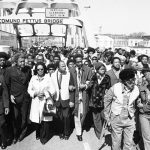
In reading Charles Denby’s “Continuing Magnolia Jungle terror exposes reality of ‘Great Society,’” one is struck by how poignant and presciently modern Denby’s thoughts were and how very little has changed today.
Readers’ Views on the 60th anniversary of News & Letters and Terry Moon’s column on it.

From Ferguson to Staten Island; Revolutionary Rojava; Youth Protest; Violence Against Women; Detroit Solidarity; Paris March; Recalling Mary Jo
From the September-October 2014 News & Letters
THE FREE SPEECH MOVEMENT AND THE BLACK REVOLUTION
I am in the movement still because of the Free Speech Movement (FSM)—it turned my life around. I studied everything about the New Left. I came to Berkeley and decided this is where I needed to be. [=>]
From the July-August 2014 issue of News & Letters
by Robert Taliaferro
Race has always been at the forefront of this nation since its founding. It seems ironic that the generation that produced the country’s first Black president is also the generation that is seeing the advances made in civil rights during [=>]
by Robert Taliaferro
Alice Neel: The Art of Not Sitting Pretty by Phoebe Hoban (St. Martin’s Press, New York, 2010).
There are many ways to be involved in a revolution. Written words defining theory and practice, and mass social protests are two ways. Creating art outside of the norm is another.
Unfortunately, for many years revolutionary [=>]
Essay
by Robert Taliaferro
The history of the U.S. is a quagmire of facts and near fictions; conflicting thoughts and ideas; established truths and myths, and nowhere is this more evident than when one discusses the causes and effects of the Civil War. This is especially evident on its 150th anniversary as some try to rewrite history, [=>]
by Robert Taliaferro
John’s writings are strikingly poignant and timeless, with a prosody that is uniquely old-school. The body of his work is eloquently instructive and historically prescient.
In reading his columns we are challenged to look upon his words as more than philosophical constructs; there is a timelessness that reminds us that history–if left to its [=>]