
Trump expanded both the war on Venezuela and the world’s spiral into war. Its connection to his war to subdue the people in the U.S. was brought home by an ICE agent’s murder of Renee Nicole Good.

Trump expanded both the war on Venezuela and the world’s spiral into war. Its connection to his war to subdue the people in the U.S. was brought home by an ICE agent’s murder of Renee Nicole Good.

Making a brief retrospective of the Bolivarian project in Venezuela, begun in 1998 with Hugo Chávez, and tracing its connections with Nicaragua and other Latin American countries, Baltodano reflects in this article about the current situation of democracy in the continent, after Venezuela’s recent elections.

The obviously fraudulent election results in Venezuela, along with the dire economic-political situation in the country, signal the impasse, if not dead end, that the decades-long call for “21st Century Socialism” has reached.

Venezuela’s president rekindled a territorial dispute with its neighbor Guyana. Not to actually take the territory, but rather to create an issue of patriotism to use in his upcoming re-election campaign.
Under the regime of President Nicolas Maduro in Venezuela, scientific institutions are falling apart.
Many in Venezuela oppose both U.S. intervention—in league with the right wing and Juan Guaidó—and the government of President Nicolás Maduro and his generals. At the same time we cannot forget that what passed for constructing “21st Century socialism” has been a problem.
We share the Statement on Venezuela by the Anti-War Committees in Solidarity with The Struggles for Self-Determination, which looks at the situation today, its history, and takes the measure of today’s Left.
Maduro’s authoritarian rule must not give a green light to intervention from without, or to supporting a coup from within. That cannot be allowed to cover up the way that the attempt to construct socialism from the top down was no substitute for a social transformation from below.
Editorial on the situation in Venezuela including the deterioration of living conditions; the repression practiced by the United Socialist Party of Venezuela and their attempt to gut Venezuela’s Bolivarian Constitution; and the personality cult built around Hugo Chávez, revealing contradictions in the movements for freedom. .
As Venezuela’s social crisis deepens, the contradictions always present in Chavismo are coming to a head. A look at the Bolivarian Constitution, Chavismo’s relationship to the Arab Spring, and its dependence on high oil prices and a top leader illuminate the crisis.

Readers’ Views on Philosophy and Revolt vs. Trumpism; Trump and the Left; Injustice to Immigrants; Anti-Woman, Anti-Labor Uber; ACT UP; From Iran; To Mexico; Why Read News & Letters?
Despite difficulties, there are tendencies within the Left in Venezuela and Latin American who are critical of Maduro and trying to work out support of the Venezuelan masses, along with opposition to neoliberalism and U.S. imperialism.
During this time of economic, political and societal crisis, including shortages of food and medicine, can Venezuela’s people build a society that is truly human, thus showing the way for the rest of the world?

The essay takes a critical look at the “Latin American Pink Tide” (a decade of progressive governments in South America), its limits and contradictions, and poses the question: Is there a way forward that does not substitute statism for the action and thought of the masses?
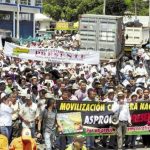
Venezuela is in ever-deepening crisis–including electricity shortages, outrageous inflation, food shortages–because of neoliberal politics. Colombia sees a cease-fire agreement signed between the government and Fuerzas Armadas Revolucionarias de Colombia/FARC while agricultural injustice, a major cause of increasing poverty, remains. Peru elects Pedro Pablo Kuczynski, a right-wing neoliberal, as their new president, defeating Keiko Fujimori, daughter of jailed former president Alberto Fujimori, who committed many human rights abuses while in office.
Part V of the Draft Perspectives 2016: Together with the depths of counter-revolution, the passion for philosophy points to both the need for and the potential for totally new beginnings in the transformation of society, for new banners of freedom as a polarizing force.
It was a stunning defeat. Where to now for the Venezuelan masses who supported Chavez in power, but many of whom feel disappointed in the post-Chavez period?
What began in early February as a small student protest against a sexual assault at a university campus in the state of Tachira, which the government repressed, spread to a number of other campuses and cities, where demonstrations were also repressed and students arrested. Seizing the moment, a faction of the right-wing opposition party called for more protests, demanding the removal of President Maduro from office.
The close Venezuelan elections of recent years have likely represented the tensions inherent in Chavismo itself. While Hugo Chavez did do things to benefit many of the poorest Venezuelans, he also maintained a relationship with the business community.
News & Letters, Vol. 58, No. 3
May – June 2013
Draft for Marxist-Humanist Perspectives, 2013-2014
Capitalism’s violence, masses’ revolt show need for total view
The world today is riven between the creativity of masses in revolt and the violent degeneracy of counter-revolution, whose destructiveness even extends to the revived specter of nuclear war two decades after the collapse [=>]
The reelection of Hugo Chávez as president is an important moment in Venezuela and Latin America as a whole. After more than a decade in power—during which his administration practically eliminated illiteracy, drastically reduced misery and poverty, including far greater access to food and healthcare, and improved housing—the majority of the population continues to support [=>]
Lead
Obama’s re-election doesn’t end clash of two worlds
The two worlds of the rulers and the ruled shone through the suffocating blanket of propaganda surrounding the election in which Barack Obama won a second term. A pronounced gender gap and long lines at the polls in African-American and Latino areas reflected the determination to defeat the [=>]