
by Adele
The author of Cults Like Us, Jane Borden, is a cultural journalist, and wanted to understand how authoritarian tendencies culminating in the Trump regime and the January 6 insurrection could be possible in modern, democratic America. She traces U.S. authoritarianism back to Puritan culture, which exhibited most of the characteristics of a cult. Puritan culture became more secular and capitalist, shaping today’s popular culture.
Borden draws upon the work of experts on cults, alternatively called “high-control groups.” Using several recent case studies, she explains what makes a group a cult. She describes how cult characteristics emerged from Puritanism and became engrained in U.S. culture.
HOW CULT LEADERS CONTROL THEIR FLOCKS
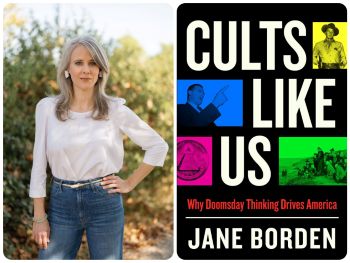 Cult leaders practice coercive control on members, restricting their behavior and access to information. They teach members to police their own thoughts, known as “brainwashing” or “thought reform.” Members are abused emotionally, sexually, and financially, often working long hours for free. They are made to feel shame and unworthiness while also believing they are in a special group. Outsiders are considered evil and impure.
Puritans demanded complete obedience to authority and doctrine, emphasizing purity, perfection, and public shaming. Individuals had intense, introspective prayer sessions to determine whether they were among the few “elect” chosen by God for “salvation.” They believed the “elect” proved worthiness by constant hard labor, which always resulted in wealth. Poor people had only themselves to blame and were rejected by God. This “Protestant work ethic” was a factor in the Puritans replacing their earlier communal values with capitalism.
Cults teach members self-blame for not working hard enough. This is especially apparent in multi-level marketing cults, aka pyramid schemes, like Amway. Meanwhile, wealth is redistributed from the members to leaders as it is in capitalism. Politicians blame people for not overcoming poverty while removing their means to do so. An example is “welfare reform” that requires people to work low-paying jobs, forcing them to drop out of education that would prepare them for a better job.
CULTS, CRISES AND CAPITALISM
Cults thrive in times of crisis or uncertainty, telling members they are the few chosen to survive the end of the world. This is derived from Biblical passages misinterpreted as doomsday prophesy. Puritans wanted to establish the utopia of the “New Jerusalem” in the New World. This would trigger the Second Coming of Christ, who would destroy unbelievers and the physical world. The belief that nature and our bodies are evil makes them expendable and exploitable.
When doomsday fails to materialize, aggrieved resentment builds. Cults eventually turn to violence, and many aggrieved people join MAGA or right-wing groups to make sense of crises or financial collapse.
Borden references “The American Monomyth” (1977) by Robert Jewett and John Shelton Lawrence. They described our indoctrination to accept violence by a repetitive theme in movies and TV. A Christ-like, reluctant hero violently purifies society of corrupting individuals, restoring it to an Eden of law and order. The authors trace this apocalyptic theme to popular Puritan-era stories depicting rescue from “Indian captivity.” These stories justified violence, racism, xenophobia, and the taking of “wilderness” land to establish a capitalist “civilization.”
Despite this history, Borden is optimistic we can defeat authoritarianism. We can understand cult-thinking to overcome its control. We need empathy for ourselves, for the natural world, and for each other, even for authoritarian cult members. The monomyth grooms us to look for a “strongman” to solve our problems. Instead, we must organize to solve them ourselves.
This is a good review of a very interesting book on an often overlooked topic. The power of cult is real. It always built itself on the idea of an invisible abstraction like the 12th Imam of Shia Muslims, or Jesus. Millions in Iran of 1979 turned to the cult of Khomeini, thinking once they pass the crisis they can remove him. But cults, once in power, are hard to remove. I appreciate Adele’s connecting Cults to Capitalism. They seem to thrive always in the absence of Philosophy during any crisis in capitalism.