
In the latest court ruling of upside-down U.S. politics, the Supreme Court on April 29 changed the way it would interpret the landmark Voting Rights Act of 1965 (VRA), effectively nullifying any chance for voters to challenge racial gerrymandering.
ROBERTS/ALITO FINALLY GET THEIR RACIST WAY

“The Voting Rights Act of 1965 was born of the literal blood of Union soldiers and civil rights marchers.” Photo: Kheel Center, Cornell University Library, CC BY 2.0.
In 1982—when current Supreme Court Chief Justice John Roberts was working for Ronald Reagan and looking to neutralize protections of the VRA—Congress had even amended the Act in Roberts’ spite, clarifying that voters hoping to challenge racial discrimination in a district map did not have to prove intentional racism, only a racist impact (in the proportion of representatives that a minority group could reasonably expect to elect). In 2026, instead of letting Republicans in Congress try to amend the Act again and suffer the reprisal of public opinion, Roberts and five other conservative justices of the Supreme Court simply issued a majority opinion, authored by Samuel Alito, declaring they would interpret the VRA as saying that when voters challenge a map, they do have to prove intentional racism.
In a dissent, Justice Elena Kagan, joined by two other liberal justices, wrote that the VRA
was born of the literal blood of Union soldiers and civil rights marchers. It ushered in awe-inspiring change, bringing this Nation closer to fulfilling the ideals of democracy and racial equality… [And only Congress] can say it is no longer needed—not the Members of this Court…. Of course, the majority does not announce today’s holding that way. Its opinion is understated, even antiseptic. The majority claims only to be ‘updat[ing]’ our Section 2 law, as though through a few technical tweaks. But in fact, those “updates” eviscerate the law (p. 47).
Birmingham, Ala., voters Latoya Gaines and Brandon Parnell were protesting outside the Supreme Court in October 2025, when oral arguments in this case were first heard. Gaines said she came “to stand in solidarity with my people…. We believe in fair math.” Parnell added, “I’m here to fight for my voting rights because I’m a voter.”
LOUISIANA RUSHES TO DISENFRANCHISE BLACK VOTERS
Louisiana, which is the questioned state in this April 29 ruling (Louisiana v. Callais), immediately suspended primary elections so that the state’s map for electing members of the U.S. House of Representatives can change from the current map (four majority White and Republican-leaning districts and two majority Black and Democratic-leaning districts) back to the map drawn in 2022 (five majority White and Republican-leaning districts and one majority Black and Democratic-leaning district). This in a state where Black people comprise roughly one-third of the total population. Under the illogic of the Supreme Court ruling, Louisiana’s Black voters would have to present a map that still had five Republican-leaning districts and one Democratic-leaning district, but which also had two or more Black-majority districts. Only then could they prove that race was the sole factor in their state’s mapmaking, not simply partisanship.
Now, any racial minority group which predominantly prefers a different political party than the majority population’s preferred party (maybe because of discrimination supported under that party) can hope for no recourse at all under this wild interpretation of the Voting Rights Act.
TIMELINES CHANGED FOR RACIST RESULTS
Then the puppet plaintiffs in Louisiana v. Callais, who had been calling themselves “non-African Americans,” asked the Court to send their opinion down to the lower court immediately, instead of waiting the customary 32 days. Supreme Court Justice Brett Kavanaugh is already on record for denying similar swift application of justice when he was part of a 5-4 majority that ruled in favor of Black voters from Alabama on Feb. 7, 2022. In that case, he said that he could not force Alabama to comply immediately, given the short time span before the 2022 primary elections, as that “would require heroic efforts by [election officials] in the next few weeks—and even heroic efforts likely would not be enough to avoid chaos and confusion.”
Indeed, the current Louisiana governor felt self-righteously heroic, enough to invoke emergency powers really intended for natural disasters. Thus, he cancelled the state’s primary elections for U.S. House of Representatives (but other races may continue to count) and invalidated absentee votes already cast in those races. Presumably he will set another primary election date for House races after another district map can be enacted. The new map likely to pass in the state legislature has zero districts with a Black majority.

Peaceful push to the polls on Nov. 2020. Photo: Anthony Crider, CC BY 2.0.
The Supreme Court’s ruling covers all 50 states, and now Tennessee intends to crack its last Democratic-leaning U.S. House district, encompassing the city of Memphis. The state Republican party has “legal cover to redraw districts in ways that will cost Black and Latino Americans seats in Congress, seats in state legislatures and seats at every table where decisions about their lives are made,” said Memphis-based Tennessee state legislator Raumesh Akbari. A few years earlier, the state erased another Democratic-leaning district by cracking the city of Nashville into three separate districts, none of whose current representation even bothered to open a congressional office in Nashville.
About a week before the VRA ruling, South Carolina senator Lindsay Graham had already urged his state to draw out its sole Democratic-leaning district (also a Black majority district no longer protected by the VRA). And there are further implications for diluting minority voters when it comes to local elections, such as the Mississippi state supreme court, whose justices are elected from arbitrary districts instead of statewide. Multiple cities in blue, red, and purple states across the nation have majority-minority districts (formerly protected under the VRA) in maps for city councils.
After the 2020 census, Latinx community organizations in Milwaukee, Wis., pushed for a third Latinx-majority district (out of a total of 15 districts) to reasonably expect to elect a city councilor reflecting the 20% of the city who identify as Latinx or Hispanic, something they believed could galvanize change on issues of immigration and bilingual education. Nancy Hernandez, then-president of the Hispanic collaborative, said of the original map containing two districts: “What they passed and proposed really doesn’t reflect the Latino population, both its current growth pattern but especially its future growth pattern.”
DIVERSITY EFFORTS ‘DEAD IN THE WATER’
Under the new Supreme Court ruling, efforts to bring diversity to district-elected legislative/council chambers would be dead in the water if there were also a partisan intent which masks the lack of that diversity. Some states such as California still have a Voting Rights Act on the state level, which encourages cities to move from at-large representation to district-based representation. This practice has been credited with an increase in the number of Black, Latinx, Asian, and LGBT elected representatives. However, even a state law can theoretically be struck down by the U.S. Supreme Court in a future case; if, as in Louisiana v. Callais, the justices are willing to say it violates the “equal protection” of white voters.
That is how John Roberts and the other justices have finally dismantled the Voting Rights Act of 1965 in full. The fact that two thirds of the Supreme Court sees fit to gaslight the country about how racism operates in America stems from Sen. Mitch McConnell’s decision to block Pres. Obama from filling a Supreme Court vacancy in 2016, then to allow Pres. Trump to fill three vacancies during a single term.
The Supreme Court had already returned to the reactionary role it has played for most of its history. The new depths it has sunk to expose the anti-freedom nature and the virulent racism and sexism that pervade this society, putting “American civilization” on trial once again. The gains in freedom that are being rolled back now required intense freedom struggles, with Black masses at their vanguard. Nothing less is needed. As urgent as it is to deny the party of Roberts a victory in this year’s elections, it is crucial not to let the passion boiling against the reactionary Trump-Roberts drive be confined to electoral politics. That passion needs to expand and deepen into a drive for the total reconstruction of society on new human beginnings.
–Buddy Bell for the National Editorial Board of News and Letters Committees
May 4, 2026
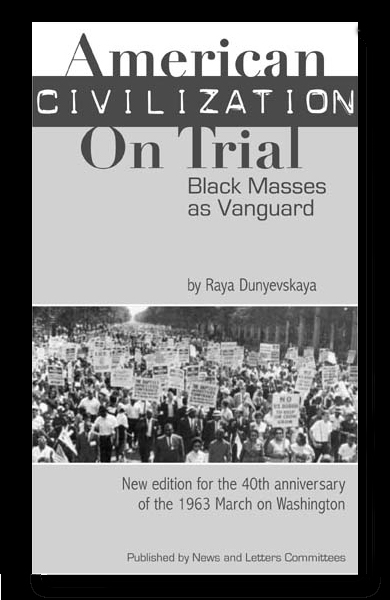
American Civilization on Trial: Black Masses as Vanguard
A book that Trumpism doesn’t want you to read! Why are Trump and the far right so determined to ban Black history from schools and universities? Because they fear its power as a revolutionary force! American Civilization on Trial: Black Masses as Vanguard by Raya Dunayevskaya tells the true story of both racism and freedom movements in the U.S. as not only past but ongoing, and as driving toward a liberatory future.
From the introduction to the third edition
Click on photo to order
The eruptions throughout the length and breadth of this country, in the year 1967, were totally spontaneous, and spoke in much clearer terms than any of the leaders….The Black masses refused to be silenced. They proceeded to search for a total philosophy on their own….
It becomes imperative, therefore, that every freedom movement re-examine its past, and map out its future in direct relationship to the continuous, the ceaseless, the ever new Black revolts. This includes all:
- the mass anti-war movement, which was born in opposition to the U.S. imperialist bombing of North Vietnam in 1965. (See The Free Speech Movement and the Negro Revolution.)
- the Women’s Liberation Movement. (See Notes on Women’s Liberation: We Speak in Many Voices.)
- those Black leaders who have maintained a distance from the Black masses. (See Black Mass Revolt.)
- the whole generation of revolutionaries searching for a total philosophy of revolution.
From “A 1980s View of the Two-Way Road between the U.S. and Africa.”
It was in his last decade that Marx discovered still newer paths to revolution. Present day existing state-capitalisms calling themselves Communist, like Russia and China, have totally abandoned both the philosophy and the actuality of Marx’s “revolution in permanence.” Marx, on the other hand, began introducing fundamental changes in his greatest theoretical work, Capital, which disclosed his new perceptions of the possibility of a revolution in technologically underdeveloped lands before the technologically advanced West. Take the simple word “so-called” placed by Marx in the title of the final part of Capital: “The So-Called Primitive Accumulation of Capital.” Though that word has been disregarded by post-Marx Marxists, it touches the burning question of our day—the relationship of technologically advanced countries to the technologically underdeveloped Third World. What Marx was saying with that word, “so-called,” was that it simply wasn’t true that capitalism’s carving up of the Asian and African world characterized only the primitive stage of capitalism.

First edition of American Civilization on Trial
To further stress that technologically advanced capitalism has not at all left behind the so-called primitive stage of turning Africa into “a warren for hunting black skins” and forcing them into slavery in “civilized” countries….Marx added a whole new paragraph to the 1875 French edition of Capital, which showed that this continued outreach into imperialism “successively annexed extensive areas of the New World, Asia and Australia.”
Marx’s projection of the possibility of a revolution coming first in technologically underdeveloped lands achieved a new meaning for our age with the emergence of a whole new Third World, as well as new mass struggles and the birth of new revolutionary forces as reason. The Black dimension in the U.S. as well as in Africa showed that we had, indeed, reached a totally new movement from practice to theory that was itself a new form of theory. It was this new movement from practice—those new voices from below—which we heard, recorded, and dialectically developed. Those voices demanded that a new movement from theory be rooted in that movement from practice and become developed to the point of philosophy—a philosophy of world revolution….
American Civilization on Trial cast a new illumination on the two-way road between Africa and the U.S. via the West Indies by showing that what, to the capitalists, was the triangular trade of rum, molasses and slaves, was, to Blacks, the ever-live triangular development of internationalism, masses in motion and ideas. This triangular development remains the dominant force to this day.
From Part VII: Facing the Challenge, 1943-1963
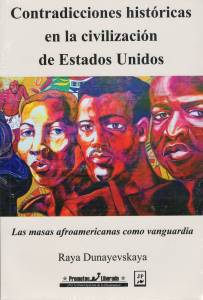
Mexican edition of American Civilization on Trial
The truth is old radicals are forever blind to the positive, the subjective new dimensions of any spontaneous struggle. Each struggle is fought out in separateness, and remains isolated. While the way to hell may be paved with Little Rocks, the way to a new society must have totally new foundations not alone in action but in thought….
The very people who played down the East European Revolts, from Stalin’s death, in 1953, through the Hungarian Revolution, in 1956, also played down the Black struggles from the Montgomery Bus Boycott, in 1956, through the Freedom Rides, in 1961, to the current [1963] struggles in Georgia, Alabama, and Mississippi. We, on the other hand, do not divide the underlying philosophy from participation in all these struggles.
Above all, we hold fast to the one-worldedness and the new Humanist thinking of all oppressed from the East German worker to the West Virginia miner; from the Hungarian revolutionary to the Montgomery Bus Boycotter; as well as from the North Carolina Sit-inner to the African Freedom Fighter. The elements of the new society, submerged the world over by the might of capital, are emerging in all sorts of unexpected and unrelated places. What is missing is the unity of these movements from practice with the movement from theory into an overall philosophy that can form the foundation of a totally new social order.
More Marxist-Humanist Literature on the Black movement for freedom

Indignant Heart: A Black Worker’s Journal, by Charles Denby
Charles Denby’s autobiography is a testament to the struggle for freedom. In Part I, Denby recounts the hardships he endured growing up as a Black person in the rural South. He escapes to the North only to discover a more sophisticated form of racism and bondage. Part II, written 25 years later, chronicles his experiences in the mid-1950s as the Civil Rights Movement was about to explode.
We hear his stories as an active participant in all the mass struggles of the next two decades—from the 1955-56 Montgomery Bus Boycott to the 1967 uprising in Detroit whose history is echoed today in the mass demonstrations following the murder of George Floyd. He takes up the radical Black Caucuses in the Auto unions that followed the Detroit Rebellion, and his participation and understanding of Marxism and the Left and how it did, and did not, comprehend the depth of thought and action of the Black freedom movement.
 Dialectics of Black Freedom Struggles:
Race, Philosophy, and the Needed American Revolution,
Contents:
Preface by the National Editorial Board of News and Letters Committees
Ch. 1. Permanent War or “Revolution in Permanence”? The Continuing Challenge of Black Masses as Vanguard
Ch. 2. The Struggle for Civil Rights and the Limits of Political Emancipation
Ch. 3. Dialectics and Economics: The New Challenges Posed by Globalized Capital
Ch. 4. Prisoners Speak for Themselves—People of Color and the Prison Industrial Complex
Ch. 5. The Self-Determination of the Idea In the African-American Struggle for Freedom
Appendix: Grenada: Revolution and Counter- Revolution, by Raya Dunayevskaya
From chapter 3:
“Of all the movements and revolts that emerged in the 1990s against reconstructed capitalism, the most significant was the Los Angeles rebellion of 1992. Though set off by the acquittal of the police officers who had viciously beaten Rodney King, the revolt called into question the entire legacy of police abuse, judicial misconduct, unemployment, poverty, and alienated conditions of life and labor that have become so endemic to the development of today’s global capitalism.”
I am a white man, but white people are fooling themselves if they think that this corrupt, racist supreme court decision will affect only black people. The SCOTUS decision that reversed and criminalized abortion also didn’t affect only women. The loss of these constitutional rights will only embolden the oppressors to continue and deepen their oppression.
We must stand together in resistance.
Do not send to ask for whom the bell tolls- it tolls for thee.