
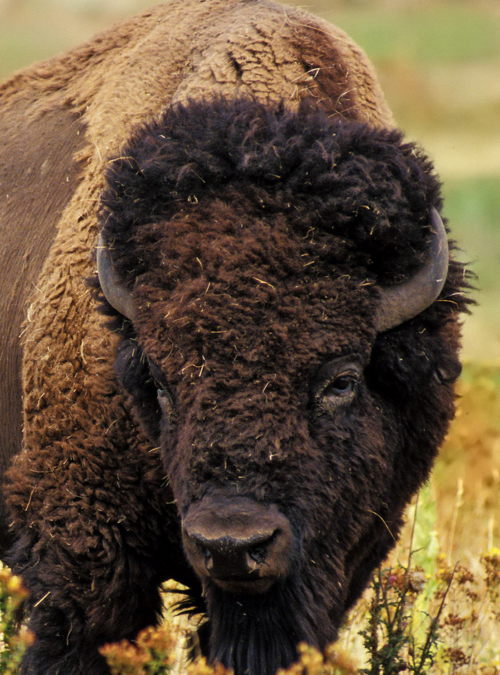
The Trump Administration has made a number of moves to take more and more Native lands by sale, letting oil and gas developers encroach, and put in place new grazing rules that deny Tribally managed bison access to federal lands in favor of “production-oriented livestock” like cattle.
As Judith LeBlanc of the Native Organizers Alliance Action Fund put it recently in an email:
Fifty Tribes manage more than 25,000 bison on land that accounts for about 95% of Indian Country… Let’s be clear: this BLM (Bureau of Land Management) proposal concentrates management of public lands in the hands of the livestock industry. If the proposal is approved, buffalo will be evicted from tens of thousands of acres of federal land and replaced with cows so corporations can benefit from hugely discounted federal grazing leases. It’s worth potentially millions of dollars in increased profits, as the BLM charges a per-animal fee 90% lower than the fees charged on privately owned land.
But people power has stopped big money interests before, and we must try to do it again. To protect our rights and sovereignty, but most importantly, protect Mother Earth and all her animals from corporate greed, we must stop this proposal while we still can.
BLM WORKS FOR CAPITALISTS, NOT THE LAND
 Meanwhile the BLM is trying to curtail the public comment period on a petition to protect Chaco Canyon. Another petition to protect Bears Ears National Monument and Grand Staircase-Escalante is also circulating.
The fact that bison herds exist at all in 2026 feels like a miracle. “The American Buffalo,” a film by Ken Burns, powerfully describes chance events: a few native and non-native Americans raising animals, and changing attitudes among the public which have so far saved the species from extinction. Prior to 1760, buffalo roamed the entire country from Maine to Florida and west to the Rocky Mountains. By 1800 they had already disappeared east of the Mississippi, but an estimated 30 million lived among Native people on the Western grasslands.
As soon as the Civil War ended, the U.S. sent the “Buffalo Soldiers” West—an army used to dispose of freed Black men and the Native Americans on land coveted for cattle ranching and farming. New production methods for buffalo hides created a huge demand for them and later for buffalo bones. New specialized guns enabled the buffalo slaughter on an industrial scale. In 1872 alone 500,000 were killed. Entire carcasses were left to rot as the meat did not generate profit. The mass extermination deprived native people, now crowded onto reservations, of their culture, food and shelter. By 1877 fewer than 1,000 buffalo remained in private herds. Natives had none to hunt, thus starvation and surrender became inevitable.
A few people began to raise calves and create private herds, including one family of ranchers and a group of Flathead natives. In 1883, 24-year-old Theodore Roosevelt spent days hunting until he found and shot a single bison.
By 1910 Roosevelt had become a conservationist—to preserve bison and large predators for sport hunting. However, his role and the popularity of entertainers like Buffalo Bill Cody’s Wild West Show and animals exhibited in zoos generated public support for 20th-century conservation.
Sadly, despite the 325,000 animals now living on both public, native and private land, loss of genetic diversity among bison and all the plants and animals in their habitats is a concern. When species “recover” from a small, near-extinct population, they are likely to be more vulnerable to future devastation or extinction from diseases, insect pests and climate change even if the public continues to remain supportive of natural wild lands. It is vital to support native and non-native advocacy, monitoring and research for the sake of future generations.
–Susan Van Gelder