
The igniting spark was the Chief Justice’s arrogant remark during a Supreme Court hearing that India’s unemployed youth were “parasites” and “cockroaches.” In response, an Indian student living in Boston posted a comment on Instagram: “What if all cockroaches come together?” Millions of Indian youths responded. A web site was built, and the Cockroach Janta (Popular) Party (CJP) came into being: “A political party for the people the system forgot to count.”
REVOLT SPREADS COUNTRYWIDE
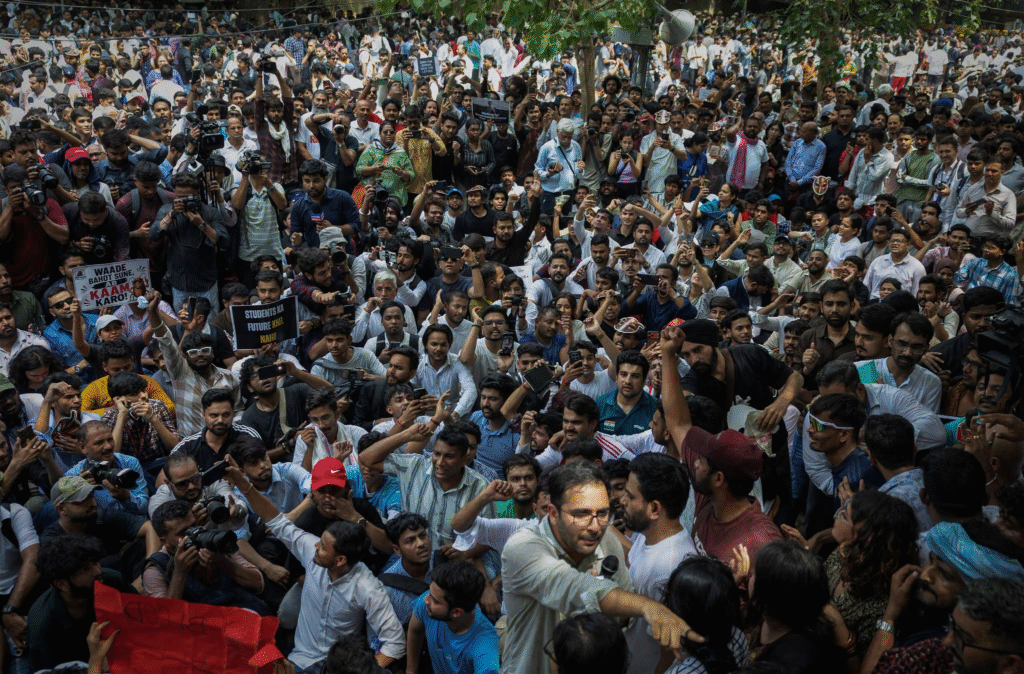
A CJP demonstration. Photo: Al Jazeera English Facebook page.
The response was not alone a social media event. Street protests were quickly organized, principally in the capital New Delhi, but in other cities as well. The initial demands centered on reforming the educational system, beginning with firing the educational minister, Dharmendra Pradhan. Thousands of youths came to participate. A well-known social activist, Sonam Wangehuk, joined the students, beginning a hunger strike. Several students joined him.
The protests continued for several weeks. A massive demonstration was called for New Delhi on July 22, the opening date for the Indian Parliament. A march toward the parliament building was scheduled and over 50,000 came, primarily youth, many traveling hours to participate. They were met with a massive show of violent force by the authorities. Batons and staves were used against the demonstrators. Tear gas canisters were deployed. Students and other young people were beaten in the streets.
In face of the government’s brutal authoritarian response, the issue has gone beyond educational reform, to the need to transform India’s so-called “democracy” under Prime Minister Modi’s autocratic rule.
DEMANDS SPREAD BEYOND EDUCATION
Initially, the principal educational demands centered on a bankrupt system, where millions of students apply to medical and other schools via entrance examination. These exams are the only way just a few students could get a job steps above manual labor, guaranteeing a decent salary. Corruption has led to these tests being repeatedly “leaked,” leading to invalid results and the need to retake an exam. Students’ time, energy, and money preparing for the tests are wasted.
Too many students commit suicide as a result of dashed hopes and disappointed families. As The Guardian noted:
The pressure on students to succeed is cripplingly high: more than two million students compete for just 130,000 places. Many families spend their life savings and get into high levels of debt to pay for their children to be coached for these notoriously grueling medical exams….More is now spent in India on private tuition than the government’s entire higher education budget.
The CJP put forth a Manifesto that, in addition to demands on education reform, include demanding that Justices—including the Chief Justice—not be rewarded with special treatment after they retire, that 50% of representatives in parliament be women, and that the news media be independent.
 Far from the violent crackdown stopping the protests, the movement continued to grow, spreading to more cities. In a rare gesture, Modi finally had to yield by getting rid of the education minister. This was a blow as Dharmendra Pradhan has long been one of Modi’s stewards in consolidating power.
Strong challenges from below have time and again confronted Modi’s regime, from the gargantuan 2020-21 farmers’ strikes to youth protesting mass unemployment in 2022, from repeated women’s marches against rape and misogynist violence, to revolt in Kashmir after Modi revoked its constitutional special status, to resistance to his racist laws and practices against Muslims. Through repression, propaganda, and electoral manipulation, Modi managed to stay in power but cannot completely suppress revolt and dissent.
This new youth movement and its supporters are fighting to make this a turning point, rather than allow the government’s concessions to disarm them. They will as well be thinking about how to avoid the fates of Gen Z revolts that toppled governments in neighboring Nepal, Bangladesh, and Sri Lanka. The question of what happens after revolution must be faced.
–Eugene Walker
In these dark times when our planet is taken hostage by wars of capitalist expansion; from Persian Gulf to Ukraine; and more and more Africans are losing their lives in silence, Eugene Walker’s Editorial on this India’s most amazing youth movement in history brings light and positive points of departure to our thought. A well timed editorial!
I have been reading for many years about protests by students in India and the corruption of the education system. And the tactic of beating them with batons is an old one. The police in India are apparently arrogant like the judges, although they have a boss to answer to. The statistic of 2 million students competing for 130,000 placements was illuminating. Private education companies must be experiencing boom times.
Since the above editorial was written, The New York Times came out with an article about how the women in the Cockroach Janta Party (CJP)—and there are thousands of them–are being singled out by police, right-wing trolls, Hindu religious fanatics and others. While horrible, it is certainly not surprising. Anytime women fight for our rights and freedom—in whatever culture—either alongside men or independently, we will be attacked in ways that men never are.
Women in the CJP are—and here we have to say “of course”—threatened with rape. Why always rape? Because that is a way that these mostly men behind these attacks think—consciously or not—that rape is how you put women in their place. Dare to step out of your god-given job of mother, wife, devoted religious follower, and rape will show you what your real role is.
The NYT explains the women “have been doxed and bombarded online by people who have called them immoral, threatened sexual abuse and acid attacks …and creat[ed] demeaning images,” one woman leader had ink thrown in her face. Their families have had cops coming to their homes. Again, “of course,” many of the attacks are anonymous but those who can hide safely behind their privileged position have also attacked the women. The example the NYT singled out a Parliament member from Prime Minister Narendra Modi’s Bharatiya Janata Party, a woman who called her sisters—who certainly represent the people of India more than she does—“Generation Gutter,” lying that the young women demonstrators had “nothing to offer the system” and were too “corrupt and ugly” to be “home makers.” Even Modi chimed in, asking “How can the daughters of this country use this kind of language?”
Again, if you dare to step outside the sphere that men have decided you must inhabit, you are ugly, trash, not fit to be a wife and mother. It would be laughable if not infuriating that Modi, whose educational system is so corrupt and broken that youth were killing themselves in despair, should chide women because they dare to use swear words in a demonstration.
Thanks for an important editorial that shows the youth revolt in India.