
The confrontation between differing classes and worldviews has been most intense in Syria, making it the test of world politics—and of philosophy and revolution. The Syrian Revolution has pushed thought about revolution to a new level.

The confrontation between differing classes and worldviews has been most intense in Syria, making it the test of world politics—and of philosophy and revolution. The Syrian Revolution has pushed thought about revolution to a new level.

Contradicciones históricas en la civilización de los Estados Unidos. Las masas afroamericanas como vanguardia: New Spanish Translation of American Civilization on Trial: Black Masses as Vanguard by Raya Dunayevskaya.
Raya Dunayevskaya’s May 12, 1953, letter on Hegel’s Absolutes needs to be read in the context of how what is embryonic is developed, and of the continuity and discontinuity in relationship to her earlier thinking and to the Johnson-Forest Tendency.
From the November-December 2014 issue of News & Letters
Readers’ Views, Part 2
PHILOSOPHY, ACTIVITY, ORGANIZATION AND SOCIALISM
I appreciate how Dunayevskaya relates Hegel’s Absolutes with the concrete tasks of building a revolutionary organization. History is the process of becoming. Hegel said that Being and Nothing are abstractions, whereas [=>]
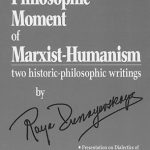
Raya Dunayevskaya’s May 12, 1953, letter—presented in two parts, beginning in the previous issue—is one of the historic-philosophic writings included in The Philosophic Moment of Marxist-Humanism.

La nueva edicion de Praxis en America Latina. Esperamos sus comentarios. Por favor, reenvíenla a sus redes y contactos.
A la barbarie del Estado mexicano, sus adherentes y secuaces, nosotros le oponemos la necesidad de construir un nuevo humanismo, la unidad de teoría y práctica —en suma: la revolución en permanencia.
There is compelling evidence that the Haitian Revolution of 1803 was a source for Hegel’s narrative on the master/slave relation in the PHENOMENOLOGY OF SPIRIT.
From the November-December 2010 News & Letters
From the Writings of Raya Dunayevskaya
Editor’s note: For the centenary of Raya Dunayevskaya’s birth, we present excerpts from her March 21, 1985, lecture at the Archives of Labor and Urban Affairs, Wayne State University, Detroit, at the opening of a three-month exhibition of the Raya Dunayevskaya Collection (RDC). The [=>]
From the January-February 2002 News & Letters
From the Writings of Raya Dunayevskaya
Editor’s Note: We publish here a discussion of what Marx considered Hegel’s greatest philosophic work—The Phenomenology of Mind. The first piece is a letter written by Raya Dunayevskaya to an Iranian colleague on June 26, 1986[1] ; the original can be found in the [=>]
From the May 2003 issue of News & Letters.
From the Writings of Raya Dunayevskaya: Marxist-Humanist Archives
Editor’s note: Raya Dunayevskaya’s “Letters on Hegel’s Absolutes” were a philosophic breakthrough that led to the birth of Marxist-Humanism. We are reprinting this 1987 commentary by her where she reexamined them in light of her effort to work [=>]
From the Writings of Raya Dunayevskaya
From the May-June 2012 issue of News & Letters.
Editor’s Note: “On political divides and philosophic new beginnings,” written 25 years ago, is the last writing of Raya Dunayevskaya, who died on June 9, 1987. It was first published in the In Memoriam special issue of News & [=>]
From the September-October 2014 News & Letters
THE FREE SPEECH MOVEMENT AND THE BLACK REVOLUTION
I am in the movement still because of the Free Speech Movement (FSM)—it turned my life around. I studied everything about the New Left. I came to Berkeley and decided this is where I needed to be. [=>]

Raya Dunayevskaya’s May 12, 1953, letter—presented in two parts, here and in the next issue—is one of the historic-philosophic writings included in The Philosophic Moment of Marxist-Humanism
Por favor, comparta con sus amigos y redes.
revista Praxis en América Latina – teoría/practica
www.praxisenamericalatina.org
No. 12, agosto-septiembre 2014
Los números anteriores: # 1, 2, 3, 4, 5, 6, 7, 8, 9, 10, 11,
Desde México
Por un socialismo de autogestión común a todos los anti-capitalistas
Panorama del movimiento estudiantil en Xalapa
“¿Por qué ya no luchamos?, ¿por qué no defendemos”: la lucha del pueblo de San Bartolo Ameyalco por el agua
Prólogo a la [=>]

From the July-August 2014 issue of News & Letters
Crowds filled Hong Kong’s Victoria Park on June 4 to remember the massacre in Tiananmen Square 25 years ago. Under Hong Kong’s separate administration they bore witness to the two-month-long mass movement of students and workers that spread to city after city across China, and [=>]

From the July-August 2014 issue of News & Letters
UNCHAINING THE DIALECTIC
Raya Dunayevskaya’s 1953 breakthrough on Hegel’s Absolute Idea enabled her to illuminate a path not traveled by previous generations of revolutionaries. She is quite emphatic in raising the importance of “Unchaining the Revolutionary Dialectic” (May-June 2014 N&L), and capturing what [=>]

Suddenly, a generation of new radicals was born to replace “the silent generation” of the 1950s. By winter 1964 a new form of revolt, with a new underlying philosophy, called itself the Free Speech Movement. It becomes necessary to view the moment when the student revolt culminated in a mass sit-in.
When you are despised for who you are, as those murdered by Elliot Rodger were—and women are not the only ones on a list that includes any differently sexed person, immigrants and all minorities but especially Blacks, people with disabilities, and that’s only in the U.S.—then a revolution has to be more than an economic change, it even has to be more than “from each according to his or her ability, to each according to his or her need.” Revolution has to be so deep and total that all human relationships are transformed. To do so, it must be total from the start…

Revolution and counter-revolution contend now, while the prolonged global capitalist economic crisis refuses to end. The question arises: where is the needed banner of total uprooting of the system and creation of new human relations as the goal? This objective need is present in every struggle from outright revolution in the Middle East to movements in the U.S. Beset by attacks and contradictions, they have in turn sparked counter-revolutions.
May-June 2014 News & Letters online: “From the U.S. to Ukraine, crises and revolts call for philosophy”; “Unchaining the revolutionary dialectic”; much more…
To understand today we must begin at the beginning, that is to say, as always, with Marx. Specifically the two periods are: the first and the last, the first being the philosophic moment, 1844 [Marx’s Humanist Essays or Economic-Philosophic Manuscripts]. That laid the ground for all future development. The last being the long hard trek and process of developments–all the revolutions, as well as philosophic-political-economic concretizations, culminating in Capital. Yet the full organizational expression of all came only then, i.e., the last decade, especially the 1875 Critique of the Gotha Program. Why only then?
March-April 2014 News & Letters: Women fight for freedom against growing retrogression; On THE Philosophic Point and Dialectics of Organization and Philosophy; Capitalist economy is failing; Ukraine and Bosnia: historic uprisings; more…
News and Letters Committees has posted its
OFFICIAL CALL FOR CONVENTION
to Work Out Marxist-Humanist Perspectives for 2014-2015
February 23, 2014
To All Members of News and Letters Committees
Dear Friends:
The sharpness of revolution and counter-revolution contending now, while the prolonged global capitalist economic crisis refuses to end, cries out for a philosophical [=>]
The impasse in the anti-capitalist movement after Occupy has led to theoretical stirrings over what to do organizationally, not just about the abolition of capitalism, but a positive concept of the future after capitalism. This is an opportunity to engage Marx’s view of these concerns, which was rooted in his 1844 declaration of a revolutionary humanism as the positive in the negative that opens up to a totally new future by refusing to be defined by what it is against.

As a contribution to Black History Month we reprint Raya Dunayevskaya’s memorial for Charles Denby (1907-1983), her comrade of 35 years, Editor of News & Letters from its founding in 1955 until his death and the author of Indignant Heart: A Black Worker’s Journal.
l’Archive Internet de Raya Dunayevskaya section française commence à être construit (the Raya Dunayevskaya in French translation section of the Marxists Internet Archive is beginning to be built):
http://www.marxists.org/francais/dunayevskaya/
Aujourd’hui:
Raya Dunayevskaya
Esquisse biographique
1948
Le cas Eugène Varga
1957
Marxisme et liberté (extraits)
1958
Situation mondiale
1960
La crise mondiale et le vide théorique
Bureaucratie et capitalisme d’Etat
1965
Subjectivisme et politique
“La crise mondiale [=>]
Readers’ Views from Nov.-Dec. 2013 N&L: U.S. RACISM AND BLACK AND LATINO STRUGGLES; LABOR UNDER ATTACK; CTA vs. THE HOMELESS; DISABILITY AND HUMANITY; ABORTION IS A HUMAN NEED; EGYPT’S CONTRADICTIONS; DETROIT CRISIS; NUCLEAR PERIL; WHY A NEWSPAPER LIKE N&L?
Faruq, a prisoner at Pelican Bay State Prison in California, reviews “Maroon the Implacable: The Collected Writings of Russell Maroon Shoatz” (PM Press, 2013), written by a revolutionary theorist forced to endure the psychological and physical torture of solitary confinement for the past 40 years.
Over 100 enthusiastic community members in the predominantly Latino/a Washington Heights neighborhood celebrated the opening of the Word Up Community Bookstore after nearly a year of enforced exile.
We can learn a lot from the way Karl Marx is presented in contemporary biographies, even if the particular writer has his/her own ax to grind. This is certainly the case with the two recent widely reviewed works, Love and Capital: Karl and Jenny Marx and the Birth of a Revolution, by Mary Gabriel; and Karl Marx: A Nineteenth Century Life, by Jonathan Sperber.
The new September-October 2013 issue of News & Letters is online.
News & Letters, Vol. 58, No. 5
Lead
Racism and the fight against it take center stage in the U.S.
Nationwide protests erupted immediately after the outrageous July 13 acquittal of George Zimmerman for murdering 17-year-old African-American high school student Trayvon Martin last year. Within three days, thousands [=>]
The persisting economic crisis has spurred new interest in Karl Marx including “Communization Theory” which projects Marx’s dialectic as a total break with capitalism but without posing a need for dialectical mediation beyond capitalism.
Although we, as a state capitalist tendency, had been saying for years that we live in an age of absolutes, that the task of the theoreticians was the working out materialistically of Hegel’s last chapter on The Absolute Idea, we were unable to relate the daily struggles of the workers to this total conception. The maturity of the age, on the other hand, disclosed itself in the fact that, with automation, the worker began to question the very mode of labor. Thus the workers began to make concrete, and thereby extended, Marx’s profoundest conceptions, for the innermost core of the Marxian dialectic, around which everything turns, is that the transformation of society must begin with the material life of the worker, the producer.
Tunisia, Syria and Egypt show the determination of the masses to continue their revolutions in the face of vicious counter-revolution.
News & Letters, Vol. 58, No. 3
May – June 2013
Draft for Marxist-Humanist Perspectives, 2013-2014
Capitalism’s violence, masses’ revolt show need for total view
The world today is riven between the creativity of masses in revolt and the violent degeneracy of counter-revolution, whose destructiveness even extends to the revived specter of nuclear war two decades after the collapse [=>]
AT THE CROSSROADS OF HISTORY
When the Green Movement started in Iran over the 2009 election, the so-called leaders were part of the government who were against Ahmadinejad. The growth of the movement of women and youth got so big it became “out of control” by the so-called leaders. The government leaders got scared because [=>]
AMERICAN CIVILIZATION REMAINS ON TRIAL
American Civilization on Trial (ACOT) is not “Black history.” Rather, Blacks play such an enormous role in the U.S. that their history that is in ACOT is a history of America.
Octogenarian
Midwest
***
The movie Django Unchained could have been an ad for the NRA’s position on the current [=>]
Raya Dunayevskaya’s sublimely researched American Civilization on Trial: Black Masses as Vanguard (ACOT) deserves a place among the U.S.’s most honest historical treatises.
Women’s struggle for freedom has continued to develop into a worldwide movement with revolutionary content (see page 1). Unfortunately, much of the Left seems unable to hear this radical dimension of women’s struggles. A recent example is Sharon Smith’s essay,
The 150th anniversary of the Civil War, and of the Emancipation Proclamation in particular, has a lot of people talking about that history and race relations today. Steven Spielberg’s movie Lincoln is less the cause than the effect of this surge in popular interest. Lincoln is very moving and beautifully made, with excellent acting and shrewd writing.
Tony Kushner’s screenplay [=>]
From the Writings of Raya Dunayevskaya:
Editor’s note: For Women’s History Month, we present excerpts from “An Overview by Way of Introduction; the Black Dimension,” Chapter 6 of the book Rosa Luxemburg, Women’s Liberation, and Marx’s Philosophy of Revolution. The chapter serves as an introduction and overview for the book’s Part Two, “The Women’s Liberation Movement as Revolutionary [=>]
The March-April 2013 issue of News & Letters is available on the web.
News & Letters, Vol. 58, No. 2
March – April 2013
Lead
From India to Egypt to U.S., women fighting for freedom
Two recent events have shown the deep and seemingly intractable worldwide oppression of women and, at the same time, revealed women’s militancy and determination to [=>]
ARCHIVES AS LIVING
I have been following the readings for the 2012-2013 Marxist-Humanist discussions with great enthusiasm. I was especially energized by the “Women as force and reason of revolution” selections. Raya Dunayevskaya’s 1970 piece “The Women’s Liberation Movement as Reason and as Revolutionary Force” was fresh and relevant to today. This is no surprise [=>]
RAVAGES OF CAPITALISM SHOW NEED FOR NEW WORLD
The article on “Climate chaos and capitalism” (Sept.-Oct. 2012 N&L) is very relevant, especially the conclusion about how capitalism’s contradiction is that the growth of the economy, of capitalist production, means more global warming and climate change worldwide.
Activist for humans and environment
Los Angeles
***
The technologies we [=>]
A new South Asian edition of Marxism and Freedom, from 1776 until Today by Raya Dunayevskaya has been published in India.
South Asian readers can order it from Aakar Books, http://aakarbooks. com/, 28-E, Pocket-IV, Mayur Vihar Phase-I, Delhi-110 091, India. Phone: 91-11-2279-5505. Telefax: 91-11-2279- 5641. Email:aakarbooks@gmail.com.
Franklin Dmitryev
Chicago
***
In Mexico, there has come to light a [=>]
OFFICIAL CALL FOR PLENUM
to Work Out Marxist-Humanist Perspectives for 2013-2014
February 24, 2013
To All Members of News and Letters Committees
Dear Friends:
The world today is riven between the creativity of masses in revolt and the violent degeneracy of counter-revolution, whose destructiveness even extends to the revived specter of nuclear war two decades after the collapse of [=>]
Una Trilogía de Revolución
Marxismo y Libertad: Desde 1776 hasta nuestros días
Filosofía y Revolución: De Hegel a Sartre y de Marx a Mao
Rosa Luxemburgo, la liberación femenina y la filosofía marxista de la revolución
Epílogos especiales para la edición en español:
• “América Latina y el marxismo de Raya Dunayevskaya”
• “El significado del [=>]
Now off the press:
Excerpts from the Foreword:
Nobody, least of all Marxists, foresaw the great historic divide which would be opened by the Arab Spring beginning in 2010. When Mohammed Bouazizi and Hussein Nagi Felhi killed themselves to protest the miserable conditions of life for Tunisian youth, they set off a year of revolutionary struggle that [=>]
From the Writings of Raya Dunayevskaya: 150 years after the Emancipation Proclamation
Editor’s note: This year marks the 50th anniversary of the publication of the Marxist-Humanist classic American Civilization on Trial,originally with the overline “100 Years after the Emancipation Proclamation,” whose 150th anniversary was January 1, 2013. The original subtitle, “The Negro as Touchstone of History,” was [=>]