
by Eugene Walker
The World Health Organization’s most recent report reads as follows:
“. . . As of 23 September 2026, the Democratic Republic of the Congo has reported 7,890 confirmed cases, including 3,799 deaths, resulting in a crude case fatality ratio (CFR) of 48.1%. At the national level, the number of new cases reported each day remains high. However, the situation varies across the country, with some provinces and health zones experiencing much higher levels of transmission than others. The continuously high CFR, and especially the continuous high rate of deaths occurring in communities, highlights the seriousness of the disease and the persistent challenges in timely case detection and access to early and adequate patient care. . .”
The ongoing tragedy faced by thousands upon thousands of Congolese men, women and children (soon to be tens of thousands?), is more complex than simply a “disaster of nature.”
- Why did it take all the way until mid-May to recognize the seriousness of the Ebola outbreak which most likely began in January or February?
- Part of the reason is surely in the ongoing violence raging in parts of the Democratic Republic of Congo (DRC). The country has been stricken by decades of conflict over its mineral wealth and unresolved tensions from the 1994 Rwandan genocide. Rwanda-backed M23 rebels seized Goma and Bukavu in early 2025 and continue to hold significant territory in eastern DRC.
- To survive in the DRC means to find work. One place is in the gold mines. But some mining areas, like Mongbwalu, a remote hill town, are also areas where Ebola infections are out of control. Miners are working right next to each other and infections and deaths are occurring. As Bienvenue Bironyi, a miner, explained to The New York Times: “We’re still working from morning to evening, nothing has changed. What can we do? We have no choice but to work.”
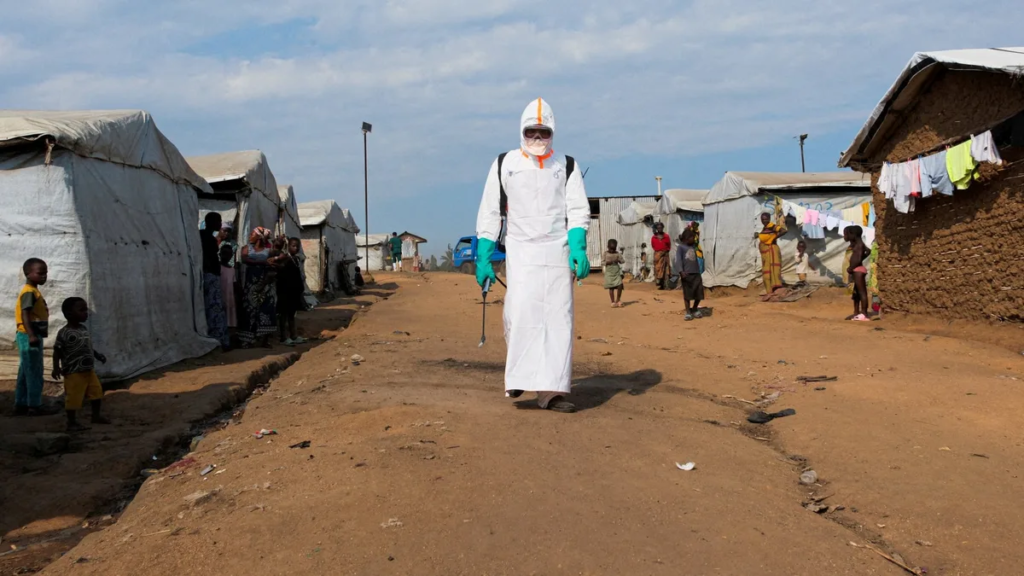
A member of the medical staff in Congo. Sunhak Peace Prize Facebook page.
Only about 100 staff members from the Centers for Disease Control and Prevention (CDC) have been deployed to Congo to help with the outbreak, compared with about 2,000 who went to West African countries during the Ebola outbreak in 2014.
In truth, this horrific moment in the DRC is only its latest tragedy. Global Conflict Tracker reports: “Since 1996, conflict in eastern DRC has led to approximately six million deaths.” (My emphasis.)
This is only one part of the world’s indifference to African peoples, as we also see in the tragedy occurring before our eyes in Sudan.