
Not only France, but much of Europe is in protest
French high-schoolers blaze new beginnings
by Eugene Walker
Europe has been shaken by a new movement that began in poor northern suburbs of Paris early in September as high school youth began to shut down their schools to protest their wretched conditions, including lack of enough teachers. Met with riot police brutality that blinded some and broke face bones in others, dozens of other high school students, and then hundreds more in Paris and dozens of other cities joined with blockades as thousands of young people came out in solidarity. They were so joined by parents, teachers, workers, and trade unions uniting in massive marches in Paris and other cities. France was burning.
To grasp these developments, the dialectic of revolt, we need to begin by grasping the voices, thoughts and actions of high-schoolers and other youth.
YOUTH VOICES FROM BLOCKADES AND MARCHES
We blockaded our school all week to demand our rights and to denounce what’s happening in our schools. Teachers are absent and compared with schools in Paris we don’t have the same resources. We’re given less money, and we don’t have the same privileges.
—Olympe, 16, high school studentWe came to support our classmates, simply because if they’re blockading, we blockade too. It’s a general movement, and they can’t do it on their own.
—Maissene, studentWe came to defend our youth. Because we’re young, the state doesn’t listen to us. They think we have no political awareness and don’t know what we’re defending. We’re here to show the opposite: we know exactly what we’re defending. We know our values.
—Raphael, 17, high school studentThis is my first demonstration. I’m here in solidarity with the high schoolers, after this week of blockades and police oppression. I’m also here for other demands: for universities, for more resources for schools, and not just schools but hospitals too. We’re really short of resources.
—Theo, 19, studentWe don’t feel listened to at all. We feel inferior, especially considering that we’re the future. So when no one listens to us, we do all this, but in the end will it really change anything? We don’t know.
—Rania, 15, high school studentWe are very angry. This is a student movement. It’s also a feminist one, an anti-racist one, an ecologist one. Just because we’re doing things differently does not mean we are wrong.
—Juliette, 18.If nothing changes, we’ll keep going for much longer. On Oct. 17, there will be a big demonstration, with high schoolers, students and farmers. So, it’ll be a bit like a new revolution.
—Rose, 16, high school studentWe are completely fed up with the living conditions, the school conditions, the work conditions that we have, and everyone is really, really deeply angry…. But what people want right now, it’s not one reform. It’s not one thing. It’s a deep change in the system and more budgets for the public services in France, which is behind all of this.
—Protester, Paris
THE REVOLT GROWS

Oct. 17, 2026, demonstration in Paris. Photo: FreCha, CC BY-SA 4.0
The youth at their blockaded schools and in the streets were met with police violence, batons, tear gas, and stun grenades, with several students injured and mass arrests. In response the movement did not retreat but grew. On Oct. 17, hundreds of thousands marched in Paris and other cities throughout France. Diane de Vignemont, a French historian and journalist writing in Truthdig.com, explains:
“In less than a month, the high schoolers’ movement managed to pull a tired, resigned country back into the streets. Students were joined by teachers, parents, doctors, nurses, lawyers, pensioners, Yellow Vests, farmers and firefighters in perhaps the most intersectional movement France has seen in decades.” She added: “The students’ insistence that their own futures are at stake has helped make connections between movements visible. In the presence of teenagers who refuse to accept that their future must be worse than their parents’ present, older demonstrators have found it harder to justify their own resignation.”
What is implicit in the students’ demands is not only an improved education system—demanding an end to dilapidated schools in poor areas, more teachers, an end to 8 am to 6 pm school days, more transparency in being able to qualify for entrance into important universities—but a questioning of present-day life as a whole, and particularly what will be their future.
EUROPE IN PROTEST
The revolt in Paris soon led others in Europe to fight for a better reality. Significant protest movements in several European countries are, at one and the same time, related to and independent of French events. (While it has not yet reached the proportions of the revolutions that began in France and spread across Europe in 1848, that specter keeps barging into the conversation.)
Serbia—Student-Led Political List Defeats Government
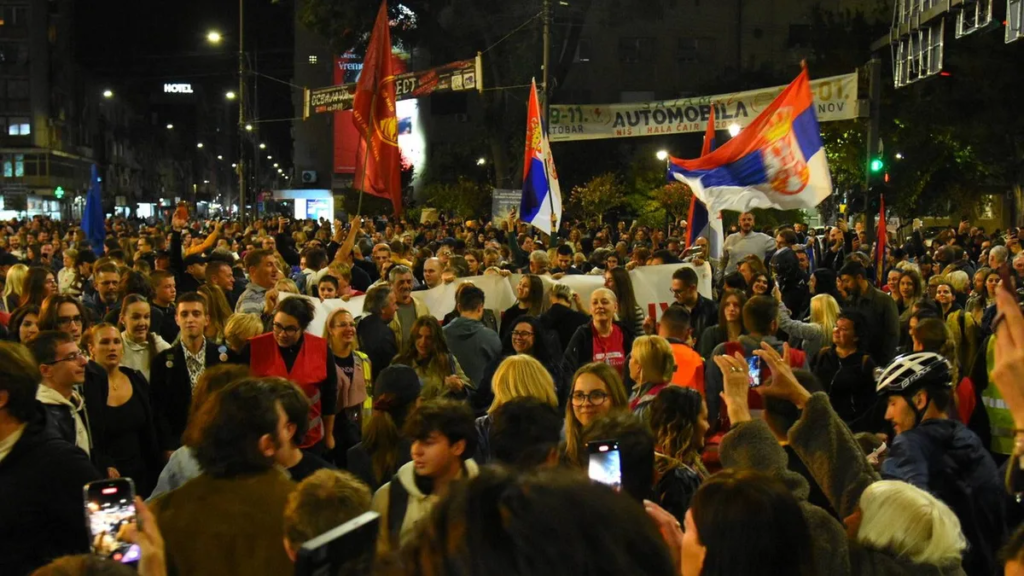
Protest in Serbia on Oct. 10, 2026. Photo: Dana / Srpske Novine, CC
Over the past two years, many Serbian citizens, teachers, professors, experts, and others have joined the students, creating a protest group that has evolved into a political movement: “Student List–Students Win.” They defeated the government in the Oct. 25 parliamentary election.
As Kosta Golubovic, a university student put it: “Change is clearly necessary. The state must belong to its people, not to the mafia and criminals. The way they treat the judiciary, the catastrophic conditions at the local level, mayors resorting to violence, dying villages—along with dubious privatizations, money laundering, the erosion of every single institution, police being replaced by thugs, and an education system vanishing before our eyes… these are some of the reasons why change is needed.”
Albania on the Edge
Extending the continuing Flamingo Revolution, students demonstrated for several days in Albania’s capital, Tirana, against poor conditions in their education system. They demanded that Prime Minister Edi Rama resign. Some set fire to several buildings across the city, including the prime minister’s office, ministry buildings and branches of several banks. Desperate to end months of protests, the government passed measures to fine protesters up to $6,130 for concealing their identity, or even if someone else at the protest is accused of violence or looting.
Housing Protests in Spain
After 87-year-old Maria del Carmen Abascal, known across Spain as Maricarmen, was forcefully evicted from her apartment, protests erupted in Madrid and other cities. Hundreds took part in pot-banging demonstrations to demand political action over soaring rents, evictions and the shortage of affordable housing. Despite the protests, the Spanish parliament refused to pass laws to prevent eviction of pensioners and to make lease renewal easier. More protests broke out. “We built a city in a week,” said one young participant. She was referring to the 1,200 tents set up in an encampment in the Puerta del Sol square in Madrid, which received tremendous support from other Spaniards, with many bringing food and water in solidarity. The average rent in Spain has almost doubled in the past 10 years.
University Students in Belgium
In Belgium’s capital, Brussels—which has already seen weeks of protests by students against university registration fees—police fired tear gas and water cannon to disperse protesters.
Portugal’s Mass Protest
In the Portuguese capital of Lisbon, an estimated tens of thousands of protesters marched against the cost-of-living crisis, low wages and an inability to access housing in major cities. House prices in Portugal have more than doubled since 2017, while rents for new leases have increased nearly as much, partly because so many wealthy U.S. citizens have moved there, buying up available properties at inflated prices.
Italian Government Crackdown
The right-wing government of Italy’s Prime Minister Giorgia Meloni has approved security measures, including the deployment of 500 troops in the financial capital Milan, to curb youth-led protests. The government has also introduced a new offense: “violent participation in public demonstrations.” It targets people gathering in groups of more than five who use potentially harmful objects including stones, sticks and fireworks. Gregorio Sorgona, a historian at the University of Palermo, said the measures do not take into account growing discontent among young people, sparked by a “fundamental contradiction”: “On one hand, the ostentatiousness of wealth and richness as a model of success; on the other, a profound crisis marked by economic precariousness. For the youth who live in poverty, the impossibility of accessing those symbols of wealth can spark violent behavior and looting. Before tackling the effects, one should act on the causes, starting with growing social inequality.”
MAKING EXPLICIT WHAT IS IMPLICIT
Returning to the French events, we want to explore their meaning for today. While the students and their supporters speak eloquently, the challenge is to take what at times is implicit in their actions and ideas and make them explicit.
It needs to be stated that what is being critiqued, protested, is not alone a broken education system, or as in Spain a housing crisis, or corruption and inequality in so many places, but to give a name, a face, to what is the source of these grave contradictions humanity is facing. It is capitalism, whether in private, neoliberal form, or in its state-capitalist manifestation, often both.
First, More than two and a half centuries after the Industrial Revolution consolidated private capitalism’s focus on the extraction of surplus value from living laborers as its form of enrichment; a century since the nascent workers’ state after the Russian Revolution was transformed by Stalin into a state-capitalist monstrosity; today, when nuclear war, climate chaos, or AI out of control could destroy us, can what the students are demanding, authentic human flourishing as their future, become our agenda, and be made real?
Second, Dialectics, as mentioned earlier, provides a pathway for making what is implicit in today’s protests explicit. In dialectical terms, opposition to capitalism is the needed first negation, the opposition to what is. But a second negation, negation of the negation, is at the heart of the dialectic. This is the positive in the negative. Thus it is not a return to the old, but is working out what we are for: a new society. This double rhythm, the core of revolutionary dialectics, is not a closed philosophic system, but the reality of humanity’s historic fight for full freedom over centuries, captured as method.
The truth of the French students’ freedom fires—and we can add the Indian youth protests against the Modi regime—are the New Beginnings that can aid us in achieving full human emancipation.
Information from Truthdig.com, Al Jazeera, The Guardian