
Revolt and Counter-Revolution, from Greece to Syria; Here Come the Reformers; Women’s Freedom; Against Racism

Revolt and Counter-Revolution, from Greece to Syria; Here Come the Reformers; Women’s Freedom; Against Racism
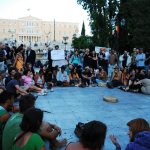
The electoral victory of Greece’s Syriza represents resistance to brutal austerity. Alarms are raised by Syriza’s alliance with the racist, theocratic Independent Greeks party.
The formal end of the U.S. war in Afghanistan at the end of 2014 was just in time for post-war wars to begin in Afghanistan itself, as well as in Iraq, Syria, Pakistan and Yemen.
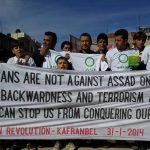
The confrontation between differing classes and worldviews has been most intense in Syria, making it the test of world politics—and of philosophy and revolution. The Syrian Revolution has pushed thought about revolution to a new level.
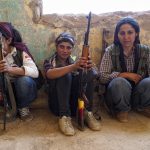
Today the heroic struggle of the Kurdish People’s Protection Units, along with allies of the Free Syrian Army, to defend Kobane from the IS deserves all support. This means first the support of the people, the workers, women, and all who struggle for a better life.
As Marxist-Humanists we call for the support of the ongoing Syrian Revolution. We call for the right of self-determination of the Kurdish people, and we call for military and political support to the heroic defenders of Kobane. This struggle isn’t just local, or sectarian, but rather it cuts deeply into the universal history of humanity’s striving for freedom.
From the September-October 2014 issue of News & Letters
Regarding “New York City and Ferguson, Missouri, police show pattern of violence against Black people” (Aug. 11 N&L web statement): In 2009 in the UK we saw something similar. Police officers killed a man in the vicinity of a political protest, then told the press [=>]
The explosive advances of the army of the self-proclaimed Islamic State (IS), crossing from Syria into northern and central Iraq, have brought deeper miseries to the Iraqi people who might have expected they had already endured the worst, including the effects of U.S. imperialist policy. Atrocities from mass shootings and beheadings to systematic kidnapping and rapes of women—that the world and U.S. foreign policy ignored when IS carried them out against anti-Assad revolutionaries in Syria—in Iraq no longer remained hidden.

The loss of lives and vast destruction visited In Israel’s war on Gaza has surpassed the horror of 2008’s “Operation Cast Lead.” Over 2,000 Palestinians have been killed to date, mostly civilians, including hundreds of children…
The war crimes being committed by the Israeli government in its current assault on Gaza are reminiscent of 2008’s brutal “Operation Cast Lead.” The bombing has not spared hospitals, UN compounds, schools or homes for the disabled. A huge percentage of the dead and injured are children. This is collective punishment on a vast, criminal [=>]

From the July-August 2014 issue of News & Letters
RESPONSES TO MARXIST-HUMANIST PERSPECTIVES
The Marxist-Humanist Perspectives (N&L, May-June 2014) give a critical assessment of the polarization between the oppressive forces of capital’s social relations and humanity’s efforts to realize human dignity. It shows humans are not just passive victims of capital. First [=>]

A lightning offensive saw Iraq’s second largest city, Mosul, fall to the insurgents. The pattern extended itself to Tikrit, farther south, then Samarra, and the battle spread to the oil refining center of Baiji. Most of this was first attributed to ISIS. The question was asked, then: Why and how could a well-armed force of 20,000 Iraqi troops, armed and trained by the U.S., dissolve in the face of 800 terrorists?
Two busloads of people from Chicago joined thousands gathered in Washington on March 15 to mark the third anniversary of the Syrian Revolution.
People from a dozen or more anti-war organizations gathered in front of the Hyatt Regency Hotel to confront former Secretary of State Henry Kissinger, named keynote speaker for the Awards Banquet of the Illinois Holocaust Museum.

A revolutionary movement in Bosnia is bringing new life to the ideas that meant everything to supporters of the 1990s people’s struggle there. Despite the efforts of bureaucrats and tyrants, the fundamental character of multiethnic Bosnia has continued to develop. At its core, the current movement is directed against the rule of capital.

Revolution and counter-revolution contend now, while the prolonged global capitalist economic crisis refuses to end. The question arises: where is the needed banner of total uprooting of the system and creation of new human relations as the goal? This objective need is present in every struggle from outright revolution in the Middle East to movements in the U.S. Beset by attacks and contradictions, they have in turn sparked counter-revolutions.
Cops beat deaf man in Hawthorne, Calif.; Assad’s forces torment man with Down Syndrome in Syria; South Carolina abuses mentally ill prisoners; disabled Chicago woman illegally evicted.
In Ukraine, an unexpected eruption of mass struggle led to the overthrow of Ukraine’s corrupt, oligarchic, and ultimately murderous President Viktor Yanukovych. In Bosnia, at the same time, massive, nationwide discontent with the corrupt system left in place when the 1995 Dayton Accords partitioned the country has led to the equally unexpected creation of new forms of democratic organization.
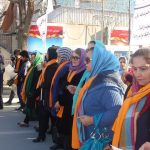
While experiences in the squares of the Arab Spring, in Turkey’s Gezi Park, in the streets of Spain and Greece, and in the U.S. Occupy Movements have revealed moments of what new human relations between women and men could look like, those moments of hope and exhilaration have been followed by devastating reaction and retrogression.
THE SYRIAN REVOLUTION AS TEST OF WORLD POLITICS
I have been active in a number of student groups around labor and women’s issues. We always talk about “intersectionality” and recognizing different struggles. Somehow that didn’t seem to apply, though, when it came to the Syrian Revolution. Suddenly people didn’t want to talk about it. I [=>]
Participant report on a New York teach-in on “Syria in the Context of the Arab Uprisings.”

“If there was no revolution in Syria, I almost feel like there would be no reason for me to exist. You don’t get tired of it. Revolution is what brought us together, as Syrians, for the first time.”

So overwhelming has been the past year’s flow of revelations about the U.S. government’s spying on virtually everyone that even President Obama’s hand-picked review panel had to acknowledge it. Though noting the potential for abuse of the state’s mountains of covertly gathered data, nowhere does the report by Obama insiders grapple with the question of just what sort of totalitarian instrument the militarized top secret government has become.
Readers’ Views from the Nov.-Dec. 2013 N&L: SYRIA AND WORLD POLITICS; WARS PAST AND PRESENT; PHILOSOPHY AND MASSES; PRISONERS READ & SPEAK
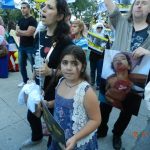
On Aug. 21 the genocidal regime of Bashar al-Assad murdered over a thousand civilians, mostly women and children, with sarin gas in the Damascus suburbs of Eastern Ghouta. It committed this crime in full view of the world—images of hundreds of murdered children, still in pajamas, laid out in temporary morgues, shocked viewers across the world.
Since April 2011 the world has looked on as over 115,000 Syrians have been killed, and over 7.2 million have been made refugees. When Assad’s regime resorted to illegal chemical weapons, it seemed to many that this would change. It seemed that the images of so many murdered innocents might compel some action.
The new November-December 2013 issue of News & Letters is online.
News & Letters, Vol. 58, No. 6
November – December 2013
Lead
The Syrian Revolution as the test of world politics
On Aug. 21 the genocidal regime of Bashar al-Assad murdered over a thousand civilians, mostly women and children, with sarin gas in the Damascus suburbs of Eastern Ghouta. [=>]
Did humanity shudder? At 3 AM on Aug. 21, the genocidal regime of Bashar al-Assad attacked the Damascus suburbs with deadly chemical weapons. Over 1,300 people, mainly women and children, died.
The new September-October 2013 issue of News & Letters is online.
News & Letters, Vol. 58, No. 5
Lead
Racism and the fight against it take center stage in the U.S.
Nationwide protests erupted immediately after the outrageous July 13 acquittal of George Zimmerman for murdering 17-year-old African-American high school student Trayvon Martin last year. Within three days, thousands [=>]
The mass protests in Turkey, the presidential election in Iran and, above all, the continuing struggle for the Syrian revolution express the depth of today’s social crisis. These crises are interpenetrated and inseparable. The stakes are high.
The Feb. 26 assassination of Tunisian Marxist Chokri Belaid is a tragedy, not least because it denies this serious and courageous activist a chance to help work out the contradictions in his own movement. His funeral—perhaps a million people took to the streets—became a massive demonstration in favor of continuing the Tunisian Revolution.
It is instructive to compare the 1990s, when pretty much only the women’s movement gave vocal support to Bosnia, with Syria today. Some of the same crimes are happening now.
Tunisia, Syria and Egypt show the determination of the masses to continue their revolutions in the face of vicious counter-revolution.
ARCHIVES AS LIVING
I have been following the readings for the 2012-2013 Marxist-Humanist discussions with great enthusiasm. I was especially energized by the “Women as force and reason of revolution” selections. Raya Dunayevskaya’s 1970 piece “The Women’s Liberation Movement as Reason and as Revolutionary Force” was fresh and relevant to today. This is no surprise [=>]
OFFICIAL CALL FOR PLENUM
to Work Out Marxist-Humanist Perspectives for 2013-2014
February 24, 2013
To All Members of News and Letters Committees
Dear Friends:
The world today is riven between the creativity of masses in revolt and the violent degeneracy of counter-revolution, whose destructiveness even extends to the revived specter of nuclear war two decades after the collapse of [=>]
Lead
by Gerry Emmett
“However partial the industrial revolt may be, it conceals within itself a universal soul: political revolt may be never so universal but it hides a narrow-minded spirit under the most colossal form.”
–Karl Marx, “On the King of Prussia and Social Reform”
The world’s rulers would like to declare an end to the earth-shaking, world-historic events of the Arab Spring, that completely unforeseen social revolt that [=>]
Woman as Reason
Meredith Tax, a women’s liberationist and political activist since the late 1960s, author of The Rising of the Women: Feminist Solidarity and Class Conflict, 1880–1917, and now U.S. Director of the Centre for Secular Space, a think tank formed to oppose fundamentalism and promote universality in human rights, has recently written an important and [=>]
Editorial
Daraya, Aug. 25: the Assad regime continues its genocide, with 300-600 estimated killed in this Damascus suburb. The dead are unarmed men, women and children of the working class. This massacre was committed to terrorize the revolutionary people of Syria, and to guarantee the security of the nearby military airfield that Assad will use in [=>]
Lead
Reactionary U.S. election shows capital’s contradictions
“We built it!” roared the delegates at the Republican Party convention in Tampa. It was the perfect expression of the presidential campaign and of capitalist thinking in general. The truth is that workers built the social wealth. Capitalists take it from the workers, and the government gets a portion.
Mitt Romney [=>]
World in View
by Gerry Emmett
Arab spring continues
Egypt
Egypt’s first presidential election presented voters with two bad choices: Ahmed Shafiq, a Mubarak ally, or Mohammed Mursi of the Muslim Brotherhood. Neither candidate has any connection to the working women, the youth, or the mass self-organization that have been at the heart of Egypt’s revolution.
This election showed [=>]
World in View
by Gerry Emmett
“None of us believe that peace is so sweet or life so dear that we are willing to sell our freedom at the price of chains and slavery.”
These words of a young Syrian woman express the passion that animates the Syrian Revolution now facing the most brutal, determined opposition from Assad’s [=>]
Chicago–“Some of us killed innocents. Some of us helped in continuing these wars from home. Some of us watched our friends die. Some of us are not here because we took our own lives. We did not get the care promised to us by our government. All of us watched failed policies turn into bloodshed. [=>]
From the May-June 2012 issue of News & Letters:
Draft for Marxist-Humanist Perspectives, 2012-2013
Counter-revolution’s rise shows need for a total philosophy
This special issue carries our Draft Perspectives Thesis, part of our preparation for the national gathering of News and Letters Committees. We publish it because our age is in such total crisis, facing a [=>]
Draft for Marxist-Humanist Perspectives, 2012-2013
Counter-revolution’s rise shows need for a total philosophy
Revolution, having forced its way to center stage over the last year and a half, cannot easily be bottled up. That explains the viciousness of the counter-revolution, whether the violent police attacks on occupations from New York to Oakland or the Syrian state’s torture [=>]
Lead
by Gerry Emmett
The unprecedented uprising in Syria has been called the “orphan revolution” because it seems that the Syrian people have stood almost alone in their epic struggle for freedom. The Arab League observers achieved nothing. The UN has been stymied by Russian and Chinese vetoes in the Security Council. Most recently, the meeting in [=>]
Lead
Syrian revolution fights Assad’s genocide, world powers watch
The Syrian Revolution is a serious challenge to the order in the region and beyond. Israel, Iran, and Saudi Arabia all have much to lose from the overthrow of Bashar al-Assad’s Baathist family dynasty, as do their imperialist patrons.
From the Writings of Raya Dunayevskaya
Women as thinkers and revolutionaries
Working-class [=>]
OFFICIAL CALL FOR CONVENTION
to Work Out Marxist-Humanist Perspectives for 2012-2013
February 26, 2012
To All Members of News and Letters Committees
Dear Friends:
Where we must begin is with the world in upheaval, from Occupy Wall Street to Arab Spring, still going after more than a year.
Nothing better shows the old order’s bloody desperation to prevent a [=>]
World in View
by Gerry Emmett
Nothing has posed the old truth that “the opposite of revolution is war” more starkly than the ongoing struggle for freedom by the people of Syria. In bringing the mass mobilizations that have become known as the Arab Spring, or al-Thawra (the Revolution), up against the imperialist maneuverings of all major state powers, [=>]
Lead article in the new January-February 2012 issue of News & Letters:
Widening labor and peasant revolts threaten Chinese rulers
by Bob McGuire
Open rebellion in the village of Wukan in December revealed the forced land seizures that have underpinned China’s industrial expansion as it has risen to serve as the world’s workshop. What rulers in [=>]
Editorial
While the world’s attention focused on the long-expected fall of Libyan dictator Muammar al-Qaddafi, the Syrian regime of President Bashar al-Assad has conducted a Ramadan massacre that ranks as one of the greatest atrocities of the counter-revolutionary reaction to the Arab Spring. The Syrian masses will certainly take heart at Qaddafi’s defeat, however he might [=>]
News & Letters, Vol. 56, No. 5
September-October 2011
Lead
Political spectacles cannot hide reality of deranged capitalism
At the end of a months-long political spectacle in Washington–manufactured over irrelevancies concerning what should have been a routine raising of the national debt limit before the Aug. 2 deadline–reality struck with a bombshell: the anemic “jobless” recovery in the U.S. [=>]