
by Will

Karl Marx
What could be considered one of Marx’s most important concepts—one that is the ground for much of his revolutionary humanist philosophy? It is one that mediates ourselves with all of nature and changes reality to align with our human nature. The concept in question is Life Activity.
Life Activity is simply the objectification of our species-life, our consciousness, our subjectivity. It is the active organism that relates itself to the material or natural world, reproducing itself in this metabolic relationship (the relation between humanity and nature) to keep itself alive. While Life Activity is universal to all living organisms in this universe, it is with human beings that this life activity is conscious and separate. We are able to separate ourselves from the spontaneously developed labor process, doing more than simply reproducing our immediate needs. Human life activity is unique in that “the whole character of a species is contained in the character of its life activity; and free, conscious activity is his species being.”[1] This is our Species-Being, our human essence, our freedom.
WHERE HEGEL AND MARX DIFFER
However, it must be clarified that our nature does not express itself in an unmediated way; it is particularized in each historical form we live under at the time. It follows that what our nature expresses itself as is predicated on our Life Activity or labor. This was Marx’s discovery of his new humanism—what later Marxists would call historical materialism. Unlike Hegel, who believed that history was the development of historical categories or notions driven by the act of consciousness, Marx’s dialectic centers on the material, living, breathing, and dependent human being. Although Hegel does believe that labor itself is the real expression of human consciousness, as Raya Dunayevskaya notes in Philosophy and Revolution: From Hegel to Sartre and from Marx to Mao, for him that is merely “thought labor.” The human being can only create and live in relation to nature, for if there is no nature, there can be no human being.
Furthermore, the historical process so far is one that Marx termed “prehistory.” The reason he labeled all hitherto history as prehistory is because it has been a process of overcoming alienation and still is. This is why Marx describes history not as the philosopher Stephen Houlgate would say—”technological change”—but as the history of class struggle. As Marx said in The Communist Manifesto in 1848, “The history of all hitherto existing society is the history of class struggles.” Alienation is the reason why the whole of history is a process of class struggle, because, as Marx notes,
But on analysis of this concept [alienated labour], it becomes clear that though private property appears to be the source, the cause of alienated labour, it is really its consequence, just as the gods in the beginning are not the cause but the effect of man’s intellectual confusion. [2]
(It should be noted that in The Communist Manifesto, Engels adds a footnote to the famous line on class struggle mentioned before, writing “all written history,” which Dunayevskaya critiques in Rosa Luxemburg, Women’s Liberation, and Marx’s Philosophy of Revolution.[3])
But what is alienation? Psychoanalyst and Marxist philosopher Erich Fromm defines it as follows:
“Alienation (or ‘estrangement’) means, for Marx, that man does not experience himself as the acting agent in his grasp of the world, but that the world (nature, others, and he himself) remain alien to him. They stand above and against him as objects, even though they may be objects of his own creation. Alienation is essentially experiencing the world and oneself passively, receptively, as the subject separated from the object.”[4]
‘ESTABLISHING NEW FORMS OF FREEDOM’
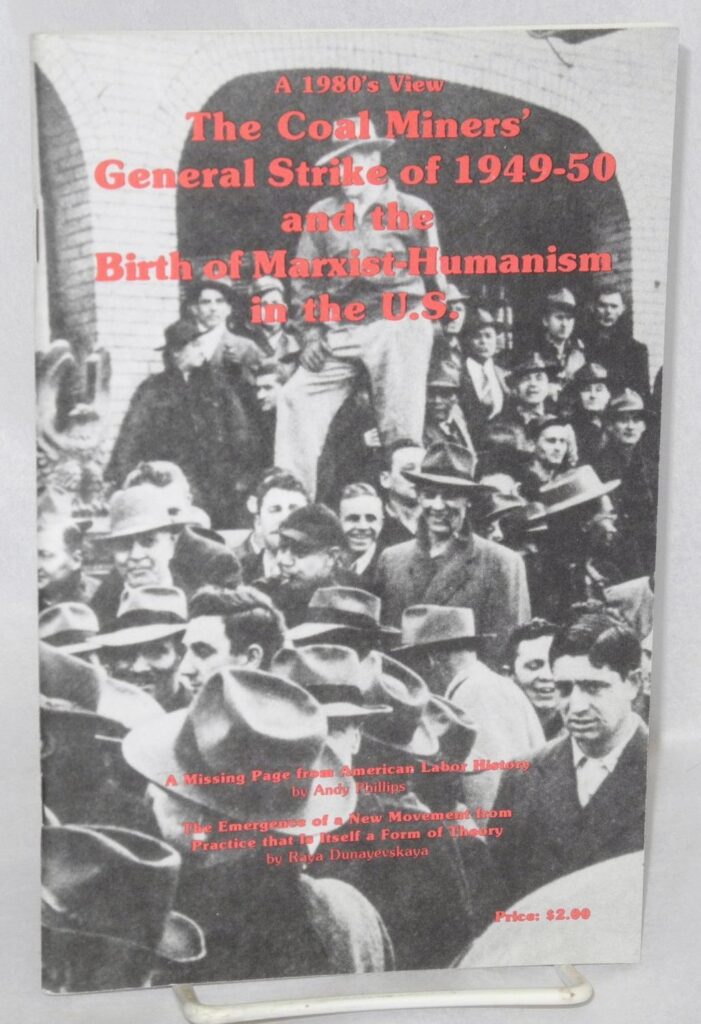
Click to order a copy of the pamphlet.
History is this movement of overcoming alienation and establishing new forms of freedom. In new forms of life, this comes with all the new (and sometimes leftover) social and material baggage, such as various religions or social customs and traditions. However, with the transformation of production also comes a change in consciousness—from an animalistic communal existence through the isolated individual of Modernity to (hopefully) an individual fully conscious of their own freedom as a process of becoming in all their dimensions.
Class struggle, or the new passions and forces of revolution, is not just a negative revolt against what is, but an active, reasoning, creative force—a self-developing Subject. It is this force that will create the new society through its own organs and establish what Marx would call “a free association of producers.” This association will tear down the fetishisms of capitalist society and turn labor from a means into an end, creating a truly conscious and free Life Activity.
An example lost in labor history—which was a part of what created the practical-theoretical experiences that led to the creation of the Marxist-Humanist tendency—is the 1949–1950 coal miners’ general strike in the United States. In their alienated work, they fought against a new stage in capitalist development: automation. The miners protested the implementation of what they accurately named “a man killer”—and that it was. This strike made against the wishes of the union bureaucracy garnered support from workers in multiple industries.[5] This revolutionary act created independent organs of worker power, embodied by women and men who questioned not only their working conditions and wages, but the very form of labor itself.[6] It is this manner of revolt, of free association, that creates a new stage not only in matter, but also in mind.
The reason why this act of self-activity is important to Marx’s concept of Life Activity is because it was the miners in their own struggle against capital that brought out explicitly what was already implicit in the workers themselves, and that is the outright rejection of the type of labor they were doing to begin with. It is the drive of human beings to be fully universal, that makes Life Activity so pivotal to Marx’s philosophy.
1 Economic and Philosophic Manuscripts of 1844 by Karl Marx (Marx-Engels Collected Works vol. 3, Progress Publishers, 1975, p. 276).
2 Economic and Philosophic Manuscripts of 1844 by Karl Marx (ibid., pp. 279-80).
3 Rosa Luxemburg, Women’s Liberation, and Marx’s Philosophy of Revolution by Raya Dunayevskaya (University of Illinois Press, 1991), pp. 119, 196n17.
4 Marx’s Concept of Man by Erich Fromm (Frederick Ungar Publishing Co., 1961), p. 44.
5 The Coal Miners General Strike of 1949-50 and the Birth of Marxist-Humanism in the U.S. by Andy Phillips and Raya Dunayevskaya (News and Letters, 1984).
6 See also On the 100th Anniversary of the First General Strike in the U.S. by Terry Moon and Ron Brokmeyer (aka Ron Kelch) (News and Letters, 1977).
Workers of the world unite ! You have nothing to lose but your chains, and a world to win
“Class struggle, or the new passions and forces of revolution, is not just a negative revolt against what is, but an active, reasoning, creative force—a self-developing Subject.”
I have been considering this quote in context of a member comment during the convention, if I may paraphrase: Marx credited Hegel with working out that double negation includes a self-evaluation in which people consider how they themselves have been objectified and thus are perpetuating the system they wish to transcend.
“Class struggle, or the new passions and forces of revolution, is not just a negative revolt against what is, but an active, reasoning, creative force—a self-developing Subject. It is this force that will create the new society through its own organs and establish what Marx would call “a free association of producers.” This association will tear down the fetishisms of capitalist society and turn labor from a means into an end, creating a truly conscious and free Life Activity.” Excellent essay article! I am very grateful, and charged up for this great writing.