Takes up: a yearly 2.5% increase in self-harm cases among people aged 24 and under; proposed UK ban of pornography depicting incest where one person is pretending to be under 18; and the situation of pregnant women and girls in ICE custody.
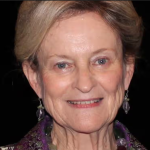
Takes up: Paula Doress-Worters, a founder of the Boston Women’s Health Book Collective, writing Our Bodies, Ourselves; far Right president José Antonio Kast taking office in Chile; and International Women’s Day demonstrations in Brazil, Argentina and Uruguay.
Takes up: the life of U.S. mathematician Gladys Brown West; and the insufficiency of laws punishing rape in cases in London, Germany and France.
Takes up: the first woman-led campaign by Workers Defense Project protesting the working conditions of housekeepers; Canada cancelling the caregiver permanent residency program; and women filing a lawsuit regarding unnecessary medical procedures by gynecologist Javaid Perwaiz.
Takes up: spread of the Nordic Model in Europe, i.e., decriminalizing victims of prostitution while criminalizing pimps and customers; and 2025 International Day for the Elimination of Violence Against Women.
Takes up: Mary “May” McGee, who won a 1973 Irish Supreme Court case legalizing contraceptives; Despite a Nov. 6 protest of over 10,000, the Latvian parliament voted to exit the Istanbul Convention against violence against women; Women for Change in South Africa organized a protest against a femicide rate five times higher than the global average.
Takes up: the life of anti-gender violence activist Susan Xenarios; South Korean women suing the U.S. military for maintaining a network of prostitution; World Women’s March in Canada; and an anti-femicide march in Argentina.
Takes up: proliferation of women’s “co-living spaces” in China; 51st anniversary of Studio D, the only publicly-funded feminist filmmaking studio in Canada; a march in Spain demanding worldwide abolition of reproductive surrogacy; and the Women Against the Far-Right campaign in Great Britain.
Takes up: a demonstration in Lippstadt, Germany, against Evangelical Lippstadt Hospital’s decision to stop providing abortions; a Superior Court Justice in Ontario, Canada, finding five men not guilty of sexual assault; and police removing migrants, mostly women and children, from a makeshift encampment outside the City Hall in Paris, France.
Takes up: the life of feminist activist Susan Brownmiller; the UK government announcing a bill that would criminalize pornography depicting strangulation; and International Domestic Workers Day.
Reports from participants in the June 14, 2025, “No Kings” demonstrations across the nation. Thousands took to the streets, plazas and sidewalks, not only in every state and every significant sized city, but in tiny towns and suburbs. No one wanted to miss the opportunity to oppose Trump’s cruel, inhuman, destructive policies.
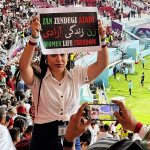
On April 19, over 300 people demonstrated against Trump and Musk in Memphis, Tenn. People of all ages were there, including families with children and many students. These ongoing demonstrations show optimism and a desire for solidarity in these times that are frightening for the whole country.
Takes up: A UN Women report about women-led and women’s rights organizations in humanitarian crisis zones; an ongoing epidemic of hundreds of domestic violence cases, including eight femicides, in Nova Scotia, Canada; and UK modernizing its voyeurism laws to keep up with abuses of advances in technology.
Takes up: the opening of Poland’s first abortion clinic; International Women’s Day in Argentina; and a march in South Africa demanding the government declare escalating levels of femicide and violence against women and children a national emergency.
Takes up: the life of feminist philosopher Sandra G. Harding, who coined the term “standpoint theory”; researched effects of online misogyny on British primary and secondary school students; and increasing global rates of incarceration of women.
On March 14, over 3,000 veterans and allies demonstrated at the National Mall in Washington, D.C., against Trump and Musk’s cuts to veterans’ federal jobs, services, and benefits. The demonstration came together quickly showing that people aim to restore democracy.
Takes up: Three Thai women rescued from a human egg farm in the country of Georgia; the third African Women in Dialogue conference; and the UN Human Rights Committee ruling Ecuador and Nicaragua responsible for violating the human rights of three girls denied abortions.
Takes up: International Criminal Court prosecutors investigating the Taliban’s horrific laws oppressing women as war crimes; the formation of a “morality police” to enforce new restrictions on women in Libya; and “deepfake” porn targeting girls in Toronto, Canada.
Takes up: Sixteen days of activism in Ivory Coast opposing violence against women; a demonstration against violence against women in Kenya; technology intended to monitor wildlife in Northern India being misused to harass and intimidate women; and the European Court of Human Rights rejects the challenge against France’s anti-prostitution law.
Takes up: Students in Seoul protest plans by Dongduk Women’s University to become co-ed; London conference by the feminist organization Nordic Model Now!, debunking the sex industry; and a mass demonstration in Rome against violence against women.
Takes up: the documentary ‘Old Lesbians’; the Taliban’s law granting authority to arrest anyone violating its 35 articles, which especially oppress women; 19 Afghan women arriving in Scotland to complete their medical degrees; and the National Assembly in The Gambia voting for female genital mutilation to remain illegal.
Takes up: Protest in Brazil against a bill that equates abortion after 22 weeks with homicide; the 4th World Congress for the Abolition of Prostitution in Montreal; women outdo fundamentalists in Turkey’s local elections; and the cancellation of a state-sponsored mass wedding of 100 orphaned girls and young women in Nigeria.
Takes up: In memoriam Faith Ringgold, a seven-decade Black American artist; research by Dr. Debby Herbenick about violent sexual behavior among college students; a paper by the Snow Leopard Trust about “Applying a Gender Lens to Biodiversity Conservation in High Asia”; and the documentary ‘You Are Not Alone: Fighting the Wolf Pack’ (2024) about the trial inspiring Spain’s #MeToo movement.
Takes up: Amazonian Initiative Movement, a Sierra Leone group fighting genital mutilation (FGM); a two-year, 7,400-mile caravan journey through 20 African countries by #FrontlineEndingFGM; Asian Women for Equality struggling to stop massage parlors and other venues of prostitution in Canada; and France becoming the first country to explicitly guarantee women’s legal right to abortion in its constitution.
Takes up: In memoriam to Dale Spender, Australian radical feminist activist, author, and broadcaster; a report on U.S. maternal death rates by The Centers for Disease Control and Prevention; and medicine’s #MeToo movement exposing the culture of sexual harassment and assaults by higher ranking male doctors.
Takes up: International Safe Abortion Day; elections in Poland; ‘Women in Revolt! Art and Activism in the UK, 1970–1990’, the first major art museum show covering the feminist art movement; and El Salvador’s anti-abortion laws.
Takes up: Mexico’s Supreme Court ruling state laws against abortion are unconstitutional; Britain’s first cohousing community exclusively for women over 50; and #SeAcabo, (It’s Over), the Spanish women athletes’ #MeToo movement.
Takes on: Lebanese woman-led media platform “Khateera”; a fine in Chihuahua, Mexico, for singing lyrics in live performances that sexually objectify or promote violence towards women, and the deaths of Dr. Susan Love and Sinéad O’Connor.
Takes up: the Taiwanese TV drama that is inspiring a #MeToo movement; the struggle to get authorities in India to take seriously accusations of rape and harassment against the chief of the Wrestling Federation of India; the legislation passed by Maine to help survivors of prostitution rebuild their lives; and Canada’s failure to implement the National Inquiry into Missing and Murdered Indigenous Women and Girls after three years of federally ordered hearings and testimonies from survivors and victims’ families.
Worldwide domestic violence has intensified: The Strangulation Clinic was opened in Surrey, B.C. Canada, as this form of violence has increased since 2014; Iraqi women and allies demonstrated at the Supreme Judicial Council in Baghdad demanding a strict law to deal with increasing domestic violence and “honor killings”; and there has been an explosion of femicides in several countries, including Lebanon, Syria, Pakistan, and Sudan.
Takes up: Canadian Dawn Dumont Walker’s struggle to keep her son and escape her abusive ex-partner; the Spanish parliament passing legislation for paid leave for debilitating menstrual pain and decriminalizing abortion, including for minors; and the life-altering and horrendous suffering of women in Bangladesh due to climate chaos.
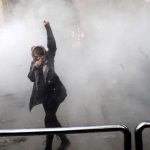
The U.S. Youth Risk Behavior Survey of 17,000 high school students revealed “America’s teen girls are engulfed in a growing wave of sadness, violence, and trauma”; women and girls in Iran are revolting against the regime by uncovering their hair and throwing out hijab; and the U.S. Women’s National Soccer Team and the Canadian Women’s National Soccer Team turned their match into a labor solidarity action.

Feminists in Armenia and Azerbaijan aim to break the cycle of violence between the countries; hundreds of acid attack survivors held a seminar in Delhi, India; Iranian women played soccer in London to support the uprising, and protested Qatar’s homophobic, sexist, and racist regime; Vancouver Rape Relief and Women’s Shelter held a vigil for at least 10 women murdered by current or former male partners in British Columbia.
Women students protest rape culture at Stanford; feminists in Gaza face backlash for campaigning against family violence against young women; Tunisian feminists protest male-dominated election structure; first woman appointed to Yemen’s Supreme Judicial Council, and women activists there win passport rights.
Women Worldwide on Pope’s apology to Indigenous peoples in Canada; Sudan rolling back rights women had won over the past two years; the conviction of Aydin Coban in Canada for sextortion, and Spain passing the “only yes means yes law”.
No Birth Behind Bars “feed-in” in London; Cross-Border Network of Mexico and U.S. abortion rights groups formed; Montreal protest of the prostitution common at Grand Prix auto race; study finds women less likely to receive credit for their scientific work.
Takes up: in a groundbreaking ruling a Tokyo Court ordered Juntendo University to compensate women because they were rejected from medical school which had tampered with their exam scores and set stricter requirements for women; women in refugee camps in Somalia created their own credit lending system; Sandbach High School’s feminist club in Cheshire, UK, launched a petition calling for the government to ban sales of school uniforms in sex shops and their use in porn videos; and the girls’ track team at Albany High School in New York launched a petition to “Stop Gender Biased Dress Codes: Allow the Girls Track Team to Wear Sports Bras.”
Takes up: feminist-led protesters in London hurling 1,000 rape alarms at Charing Cross police station on the first anniversary of the Clapham Common vigil for Sarah Everard; the launch of Somalia’s first all-female media house, Bilan; a worldwide roundup of actions on International Women’s Day; and Women Take the Wheel, an all-woman volunteer service driving women fleeing Ukraine to homes or shelters in Poland.
Women demonstrate at Boise State University against misogynist professor Scott Yenor; four male porn stars in France were charged with rape after 53 women performers complained; Sudanese women demonstrated in three cities against gang rapes by security forces; and in India, two men and a woman were arrested for creating a website pretending to “auction” over 100 Muslim women as slaves.
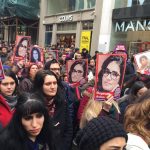
Women WorldWide takes up: Afghan women MPs set up an organization in exile to help other activist women escape; the thousands who marched in Istanbul, Turkey demanding action against widespread violence against women; women in Poland marching again against restrictions on abortion; and the 7,000 women who gathered in Madrid, Spain, protesting male violence against women.
Social media’s effects on young women’s mental health; Mexican Supreme Court bans criminalizing abortion; FiLiA2021 conference in Europe; and women boycott bars and clubs in Britain demanding better training for staff to protect women from rapists.
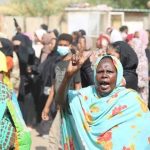
Women Indigenous leaders in Canada; forced sterilization of Indigenous women in Canada; organic farming collective Green Girls in Gaza; dangers of prenatal sex selection.
On May 1, the BC Women’s Alliance, a coalition of feminists in British Columbia, Canada, dropped banners from bridges, and other locations reading #Women Demand Guaranteed Livable Income; On May 19, 2021, Alix Dobkin, a founder of the group Lavender Jane, died; COVID-19 lockdowns contributed to a worldwide increase in violence against women, including female genital mutilation which is being fought by Lucy-Ann Ganda, a director at Sierra Leone Broadcasting Corporation.
Readers’ Views on: What Is Socialism?; What Is Marxist-Humanism?; Nuclear Socialism?; Nuclear Capitalism; Flat Earth Society; Indigenous Genocide; Indigenous Liberation; Racism Takes its Toll; Rape Culture; Coming Out in Sports; Colonialism and Liberation
Five Canadian feminist activists released The Care Economy Statement proclaiming that caregiving is a societal responsibility; through February, thousands of feminists demonstrated across France in support of “Julie,” a 25-year-old woman who when younger was raped over 100 times by 20 firemen; in memoriam for Nawal El Sadaawi, an Egyptian radical feminist, Marxist, writer and activist; and the Illinois Prison Project launched the Women and Survivors Project.
National Human Trafficking Awareness Day; Saudi activist Loujain Al-Hathloul released but not free; Scotland becomes first country to make menstrual supplies free.
Lenn Keller, a Black Lesbian feminist activist, historian, and documentary photographer, remembered; women sue MindGeek/Pornhub and pressure credit card companies; Chile women win demand for half the seats in constitutional convention; women win reinstatement in First Nation bands in Canada.
Women in Lima, Peru, demonstrate against a judge who ruled a woman could not have been raped because of her red underwear; a plaque was given to honor Mary Heaton who spent years in an insane asylum for interrupting a vicar’s sermon; a Nigerian woman started an organization in Italy to support trafficked survivors of prostitution; and in Egypt, the Cairo Criminal Court began hearings on a male university student from a wealthy, influential family accused of rape by hundreds of women worldwide who gave anonymous testimonials on social media.
Girls revolt against discriminatory dress code at Wisconsin high school; the death of Shere Hite, author of “The Hite Report: A Nationwide Study of Female Sexuality”; the struggle against mass hysterectomies performed without informed consent on immigrant women detained in Georgia; and in Mexico City feminists seized the National Human Rights Commission building for five days, renaming it “House of Refuge Ni Una Menos.”