
Draft Marxist-Humanist Perspectives for 2026-27
Part I. From war to war: Iran, Palestine, AI, climate
Part II. America 250: Counterrevolution mythologizes 1776 Revolution
Part III. Negating this world in crisis: the need to get to the negation of the negation
Part II. America 250: Counterrevolution mythologizes 1776 Revolution
“Only he who has no future is frightened of the past!”
– Raya Dunayevskaya
Amidst these global struggles, observances of the 250th anniversary of the Declaration of Independence this year serve as a battleground for today’s politics. The rewriting of the history of the 1770s-1780s is part and parcel of a combined attack on democracy and the Left.
After the defeat of Trump’s Jan. 6, 2021, coup, leading ideologues of the Right declared that counterrevolution, not conservatism, was the need of the day, and they linked it to 1776. Yes, they use the word “counterrevolution.”[1] These ideologues, who call themselves scholars, are part of a far-right network that includes the Claremont Institute, the Christian nationalist Center for Renewing America, and the Heritage Foundation, which spearheaded Project 2025, and contributed many personnel to the Trump administration, on which they have a major influence.
The answer to the revolution of the Left in 1968, which in their fever dreams actually won and took over culture and the state, is 1776, which they interpret in a one-dimensional way as the actions and decisions of the “founding fathers.”
That is to say, these ideologues erase from history the revolutionary struggles of workers, yeoman farmers, Blacks, and women—much as they desperately try to suppress today’s corresponding freedom struggles in both thought and life—and substitute the “great men,” a small elite group of wealthy white men, most of whom enslaved human beings.
BLACK REVOLT CENTRAL TO U.S. HISTORY

Black troops in the Battle of Island Mound during the U.S. Civil War. Public domain.
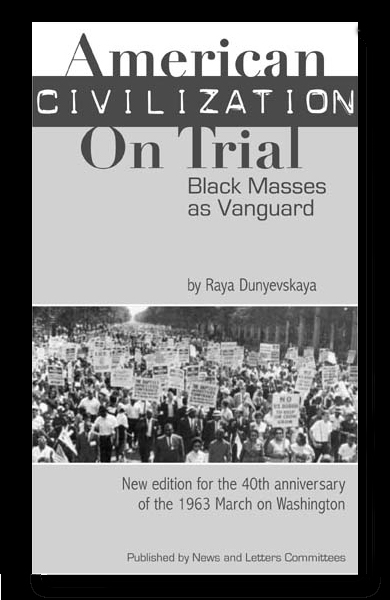
In its ideological attack on history, the Right celebrates the great birth of liberty, meaning the liberty of the few coexisting with the perpetuation of slavery. As the Marxist-Humanist work American Civilization on Trial: Black Masses as Vanguard pointed out, the founders removed the paragraph protesting slavery from the draft of the Declaration of Independence, “so that the abstractions of freedom could fit into the context of a slave society….In this first burial of full freedom’s call lie imbedded the social conflicts of today.”
The origins and nature of the U.S. republic have long been distorted, with an undifferentiated conglomeration of revolution and counterrevolution from 1776 to the Constitution fetishized as “the founding.” Each generation seems to generate a new wave of revision—most audaciously with the transformation of the Confederacy into a romantic lost cause and the Reconstruction into mob rule and corruption.
SLAVERY AND GENOCIDE, THEN AND NOW
From before the colonies broke away from England, the cornerstone of reactionary American movements has been and remains the justification or denial of this society’s foundations in the enslavement of Africans and their descendants and the genocide of the Indigenous peoples. It is no accident that U.S. capitalism remains heavily involved in both genocide and slavery—from genocidal threats against Iran to material support for Israel’s genocide in Gaza; from slave labor by many U.S. prisoners as well as domestic workers and farmworkers to reliance on goods produced by slave labor in places like Xinjiang, China, and mines in Congo.[2]
What they are also burying is the centrality to U.S. and world history of the liberation struggles against slavery, genocide, and their economic, social, political, and cultural remains that still shape social relations and material conditions—along with the whole history of struggles against women’s oppression, racism, heterosexism, and capitalism. In Hegelian terms, the true meaning of the reclaiming of history by freedom movements and their intellectual representatives is the drive of the Idea to hear itself speak.
The first Trump administration’s The 1776 Report defended slaveholding founders by claiming they had qualms.[3] The report represents the politics of those who justified slavery, tried to crush the Abolitionists, and are trying to abolish Abolitionism today in thought and in life.[4] It pretends that the Slaveholders’ Rebellion (Frederick Douglass’s accurate name for the Civil War) and Reconstruction were mere side notes to the inevitable sprouting of the “seeds” planted by the founders.
IDEOLOGY VS. HISTORY
 By no accident, The 1776 Report singles out The 1619 Project for condemnation while the administration is attacking the considerably more moderate Smithsonian Institution for not enshrining “faith in American institutions” and the idolization of the founders as “settled truths.” Any reduction of history to “settled truths” is nothing but ideology, which is the enemy of the dialectics of liberation. In that totalitarian spirit, Trump ordered “warning signs” posted outside the museum alerting the public that it was not parroting his official propaganda line.
This is an implicit recognition, in distorted and falsified form, of the ferment of ideas that emerged from movements from Black, to women’s, to queer liberation. Since the 1960s, there has been an explosion of research in history, sociology, legal studies, even philosophy, growing on the ground of the freedom movements and centering the lives and struggles of Blacks, women, working people, migrants, and sexual and gender minorities.
One of the earliest blooms of that research was the News and Letters Committees publication by Raya Dunayevskaya, American Civilization on Trial: Black Masses as Vanguard, which was first published on the 100th anniversary of the Emancipation Proclamation and was used in the Freedom Schools of Mississippi Freedom Summer, 1964. It challenged the white supremacist rewriting of U.S. history, drawing on earlier writers from W.E.B. Du Bois to Karl Marx.
U.S. HISTORY AND THE PHILOSOPHY OF LIBERATION
American Civilization on Trial traces not only political but philosophical connections between Marx and the Abolitionists, and shows how the Civil War and emancipation were instrumental in Marx working out how to restructure Capital with the struggles over the working day at its center. Marx concludes the working day chapter:
“In the United States of North America, every independent movement of the workers was paralyzed so long as slavery disfigured a part of the Republic. Labor cannot emancipate itself in the white skin where in the black it is branded. But out of the death of slavery a new life at once arose. The first fruit of the Civil War was the eight hours’ agitation…” (quoted p. 37).
As Dunayevskaya’s introduction to the fourth edition of American Civilization on Trial points out, this specifies both the reality “and the perspective for overcoming that reality” (p. 14). It is precisely because the comprehension of history does not remain in the past but reaches for the future that today’s counterrevolution is so determined to suppress that knowledge.
American Civilization on Trial demonstrated the red thread in U.S. history of Black masses as vanguard, which “also put white labor in mass production to the test” (p. 25). In developing that, it raised a Marxist-Humanist banner as an integral part of showing the meaning of U.S. history. That reclaiming of history in philosophy and philosophy in history is key to fighting the counterrevolution that combines ideological attacks with an onslaught by the state. When a freedom struggle carries on separate from a philosophy of liberation, it is doomed to remain at best another unfinished revolution, which is what allowed the retrogression we face today to flourish.
As the conclusion to American Civilization on Trial put it,
The elements of the new society, submerged the world over by the might of capital, are emerging in all sorts of unexpected and unrelated places. What is missing is the unity of these movements from practice with the movement from theory into an overall philosophy that can form the foundation of a totally new social order (p. 98).
1776 AS AN UNFINISHED REVOLUTION
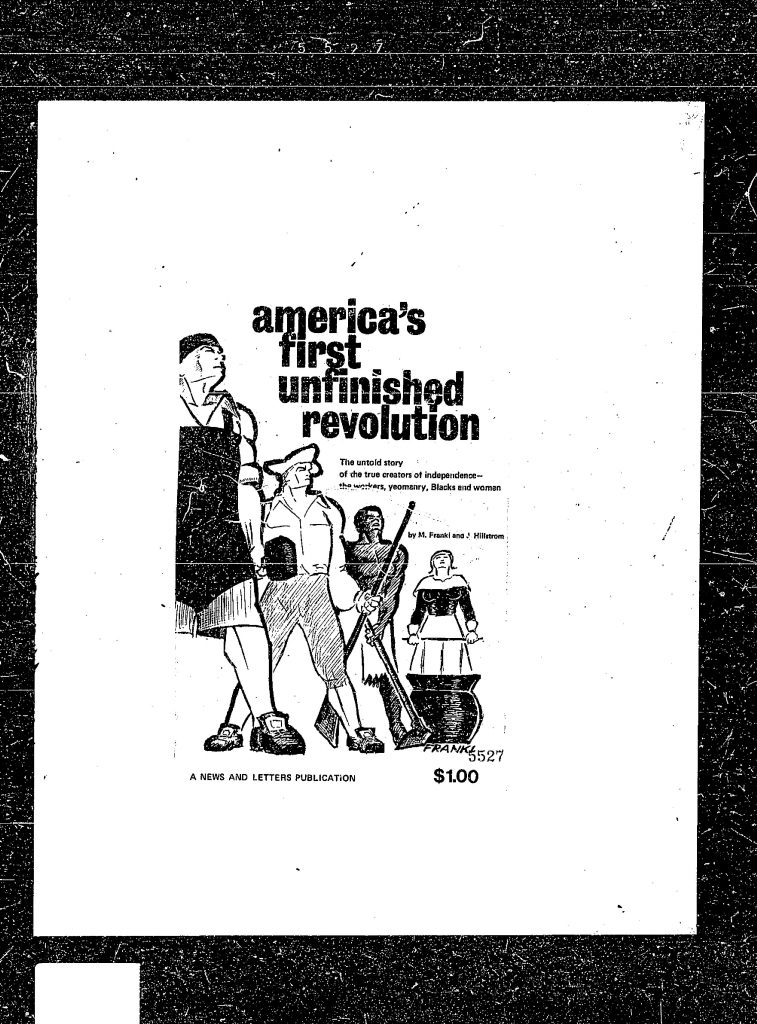 On the bicentennial of the Declaration of Independence, News and Letters Committees published America’s First Unfinished Revolution by M. Franki and J. Hillstrom, re-examining the “founding” but “with eyes of the American revolution-yet-to-be,” on the ground of American Civilization on Trial and Dunayevskaya’s Marxism and Freedom, from 1776 until Today.[5]
It showed that the upper-class leaders worked to suppress the most revolutionary impulses, which came from the workers, yeoman farmers, Blacks, and women.[6]
Rufo and Ellmers glibly invoke “America’s founding principles” only in a vague way, summed up as “citizen rule over the state”—plus order. In fact, America’s First Unfinished Revolution shows that the founders these ideologues worship went to great lengths to contain and subordinate the force and reason of masses under the command of the upper-class leaders, and explicitly aimed to limit democracy so that the wise elite would not be ruled by “the mob”—just as today’s counterrevolution uses the state to stifle “citizen rule” by the majority at every turn, especially seen in the measures Republicans take to subvert referenda establishing abortion rights.
ATTACK ON THE LEFT AND DEMOCRACY
The most blatant manifestation of this stifling is Trump’s Jan. 6, 2021, coup, which goes unmentioned in the Right’s “scholarly” tracts, and yet its baleful presence lies growling underneath. Trump and his allies have reaffirmed that attempt to abolish democracy countless times—first of all by rewriting its history as both a false flag operation and a patriotic act by innocent victims of “lawfare.” The Supreme Court’s absolution of Trump and Trump’s pardon of the rioters, plus real and proposed payouts to the Jan. 6 insurrectionists, continue to shape current politics—not least through the signal given to present and future volunteers for Trump’s fascist militias, mobs, and bureaucrats.
The administration has been attacking the Left viciously, using a definition broad enough to include anyone who runs a voter registration drive or protests ICE, anyone who is against fascism (antifa), judges who try to uphold the rule of law, even centrist Democratic Party politicians. Trump’s Reichsminister of Propaganda, Stephen Miller, thundered at an international conference that the Left is a “cancer” that must be systematically crushed and that appeals to civil liberties “must fall on deaf ears.”

Jan. 30, 2026, anti-ICE rally in Chicago. SB for News & Letters
It goes beyond rhetoric. In addition to the 41 people shot by immigration agents, the administration is conducting a mass spying campaign against activists, had protesters sentenced to up to 70 years for little more than planning protests, criminally charged protest planners, union members, an expert on the far Right, and military officers,[7] and detained journalists.
Trump and his allies in Congress and the states are carrying on a multi-pronged, years-long assault to suppress, block, or neutralize votes, intimidate election officials, and steal the upcoming elections, which polls suggest would be disastrous for the Republicans if they were fair. On top of that, they are working to deligitimize the elections in our minds, so as to make it easier to declare an emergency, to send ICE and soldiers to intimidate voters at the polls, and to decertify or overthrow the election outcome.
SELF-LIMITING DEFENSE OF DEMOCRACY
Most Democratic politicians are banking on winning votes due to Trump’s unpopularity, and not seriously planning for Trump’s plans to crush democracy. The Democratic and liberal defense of democracy is inherently self-limiting because of their narrow concept of democracy, which revolves around legal procedures and elections of political representatives. Procedure was important to the “founders,” who were worried about the restoration of tyranny from within democracy and put great emphasis on the rule of law, which implicitly means protection for the ruling class while the rulers’ laws rule over the working classes. But throughout U.S. history, Black Americans, workers, Indigenous people, and women have fought for universal extension of those freedoms, rights, and protections that this small elite promised to themselves.
Liberal ideology allows only a truncated view of how political power follows economic power. It is in denial of the fundamentally class-divided, exploitative nature of capitalist society. Trumpism pays lip service to electoral ideology at times but hollows it out to the point of meaninglessness. Sometimes the lip service slips away, as in the suggestion from the far-right Heartland Institute that not every adult “should have the right to vote”—basically excluding poor people. Calls to take away women’s right to vote are also trending.
“Democratic socialism” tries to escape liberalism’s bounds but its ideology fails to clearly reject the alienation and denial of self-activity inherent in wage-labor. The definition of socialism as “economic democracy” is self-limiting because it takes for granted that the social struggle is limited to the spheres known as economy and politics, it leaves the social relations of capitalism essentially intact, it recognizes capitalists as legitimate democratic participants when they are in fact the monopolists of the means of production, media, etc., and it does not center self-development and self-activity of masses in motion breaking away from capitalism’s law of value.[8]
What the counterrevolution does not want to allow us to understand is how democratic deficits like political unresponsiveness, inequality, and corruption are rooted in fundamental class divisions. Economic power always finds ways to bend political power. Laws and constitutional amendments may offer temporary relief, but, as the nullification of the Reconstruction’s amendments shows, what is needed is a social revolution that does not remain unfinished but continues developing in permanence.
Part III. Negating this world in crisis: the need to get to the negation of the negation
1 See “Bring on the Counterrevolution” by Christopher F. Rufo and “ ‘Conservatism’ Is No Longer Enough” by Glenn Ellmers.
2 The Global Slavery Index estimates that 49.6 million people are living in slavery.
3 In keeping with this official dogma, the administration censored an exhibit about the slaves George Washington kept at his Philadelphia home. The revised exhibit presents Washington’s unhappiness with slavery and claims he granted his slaves a “modicum of autonomy.” A group called Old City Remembers goes to the site and reads aloud the text of the informational panels removed by the administration to “bear witness to the history of slavery in our nation.”
4 The 1776 Report is reportedly included in the welcome bags the State Department bestows on white South African “refugees,” while banning all other refugees. The bags also include a propagandistic children’s book that features Elon Musk’s claim of a genocide against whites in South Africa.
6 We may note that, while some Left theoreticians exalt the form of organization of the New England town meetings, America’s First Unfinished Revolution shows that it was only when the Committees of Correspondence brought out multitudes to the meetings that they “became totally transformed from town meetings of rich colonial merchants to people’s self-participatory organs of dual power—the engines of revolution” (p. 4).
7 Obviously, no one in the armed forces has been charged with following Trump-Hegseth’s illegal orders, such as killing civilians in boats in the Caribbean. Plenty are committing war crimes in Trump’s name, but the number of service members seeking conscientious objection discharges has surged.
8 The News and Letters Committees book What Is Socialism? A Marxist-Humanist Symposium expands on how statist socialism is a substitute for the self-activity of the Subject, of masses in motion, which is the only basis for workers’ control of production and the labor process.